
 User:
User:



Constant angular speed
Storyboard 
To describe how the angle evolves over time, it's necessary to analyze its variation throughout time.
The relationship between the change in angle equals the arc angle traveled in the elapsed time, which, when divided by that time, becomes the angular velocity.
When considering a finite time interval, the angular velocity represents the average angular velocity during that interval.
ID:(611, 0)

Angle of travel
Image
Once the concept of elapsed time has been introduced, the motion can be defined in terms of the angle traveled. To do this, we need to measure:
• the current angle, which is determined as the angle difference to an origin from which we are measuring;
• the initial angle, which is determined as the angle difference to the same previous origin, and is calculated as the difference between the first and second.
ID:(12516, 0)

Angular velocity in graphical form
Exercise
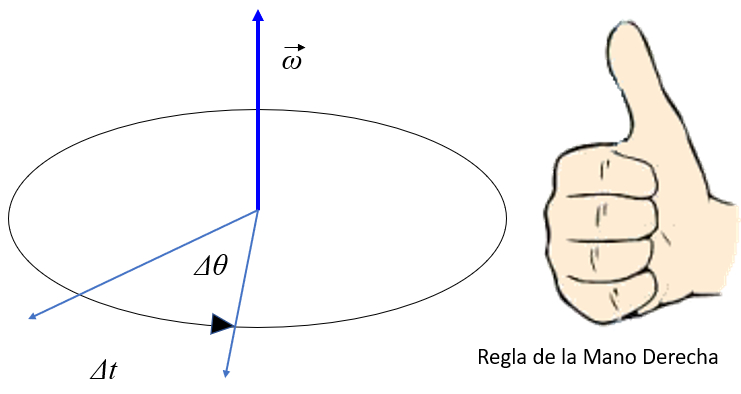
The average angular velocity is defined as the angle traversed in the elapsed time. As rotation requires an axis, it is drawn orthogonal to the disk that represents the rotating body. To integrate the axis, the angular velocity is defined as a vector in which the magnitude is the angle traversed per unit of time and the direction is defined based on the direction of the axis:
ID:(10967, 0)


Tangential speed
Script
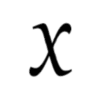
If an object is subjected to a mode of maintaining a constant radius, it will rotate as indicated in the figure. Upon observing the figure, one would notice that the mass undergoes a translational motion with a tangential velocity that is equal to the radius times the angular velocity:
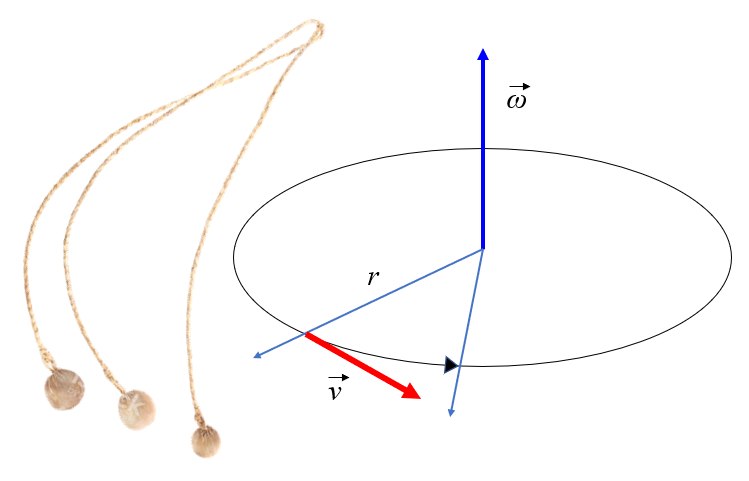
However, if the element connecting the object to the axis is cut, the object will continue to move tangentially in a straight line.
ID:(310, 0)

Constant angular speed
Description
To describe how the angle evolves over time, it's necessary to analyze its variation throughout time. The relationship between the change in angle equals the arc angle traveled in the elapsed time, which, when divided by that time, becomes the angular velocity. When considering a finite time interval, the angular velocity represents the average angular velocity during that interval.

Variables

Calculations
 to
to  ,
then, select the variable:
,
then, select the variable:  to
to 
Calculations
Variable
 Given
Calculate
Given
Calculate
 Target :
Equation
To be used
Target :
Equation
To be used

Equations
In the case where the initial Angular Speed ($\omega_0$) is equal to the mean angular velocity ($\bar{\omega}$),
| $ \bar{\omega} = \omega_0 $ |
Therefore, with the difference of Angles ($\Delta\theta$), which is equal to the angle ($\theta$) divided by the initial Angle ($\theta_0$), we obtain:
| $ \Delta\theta = \theta_2 - \theta_1 $ |
And with the time elapsed ($\Delta t$), which is equal to the time ($t$) divided by the start Time ($t_0$), we obtain:
| $ \Delta t \equiv t - t_0 $ |
We can rewrite the equation for the mean angular velocity ($\bar{\omega}$) as:
| $ \omega_0 \equiv\displaystyle\frac{ \Delta\theta }{ \Delta t }$ |
This can be expressed as:
$\omega_0 = \omega = \displaystyle\frac{\Delta\theta}{\Delta t} = \displaystyle\frac{\theta - \theta_0}{t - t_0}$
Solving for it, we get:
| $ \theta = \theta_0 + \omega_0 ( t - t_0 )$ |
(ID 1023)
As the mean Speed ($\bar{v}$) is with the distance traveled in a time ($\Delta s$) and the time elapsed ($\Delta t$), equal to
| $ v_0 \equiv\displaystyle\frac{ \Delta s }{ \Delta t }$ |
and with the distance traveled in a time ($\Delta s$) expressed as an arc of a circle, and the radius ($r$) and the angle variation ($\Delta\theta$) are
| $ \Delta s=r \Delta\theta $ |
and the definition of the mean angular velocity ($\bar{\omega}$) is
| $ \omega_0 \equiv\displaystyle\frac{ \Delta\theta }{ \Delta t }$ |
then,
$v=\displaystyle\frac{\Delta s}{\Delta t}=r\displaystyle\frac{\Delta\theta}{\Delta t}=r\omega$
Since the relationship is general, it can be applied for instantaneous values, resulting in
| $ v = r \omega $ |
.
(ID 3233)
(ID 3324)
(ID 3324)
The definition of the mean angular velocity ($\bar{\omega}$) is considered as the angle variation ($\Delta\theta$),
| $ \Delta\theta = \theta_2 - \theta_1 $ |
and the time elapsed ($\Delta t$),
| $ \Delta t \equiv t - t_0 $ |
The relationship between both is defined as the mean angular velocity ($\bar{\omega}$):
| $ \bar{\omega} \equiv\displaystyle\frac{ \Delta\theta }{ \Delta t }$ |
(ID 3679)
If we start from the starting position ($s_0$) and want to calculate the distance traveled in a time ($\Delta s$), we need to define a value for the position ($s$).
In a one-dimensional system, the distance traveled in a time ($\Delta s$) is simply obtained by subtracting the starting position ($s_0$) from the position ($s$), resulting in:
| $ \Delta s = s - s_0 $ |
(ID 4352)
If an object is at a distance equal to the radius ($r$) from an axis and rotates by ERROR:6066.1, which with the angle ($\theta$) and the initial Angle ($\theta_0$) is
| $ \Delta\theta = \theta_2 - \theta_1 $ |
it will have traveled an arc length the distance traveled in a time ($\Delta s$), which with the position ($s$) and the starting position ($s_0$) is
| $ \Delta s = s - s_0 $ |
This arc length can be calculated by multiplying the radius ($r$) by the angle, that is,
| $ \Delta s=r \Delta\theta $ |
.
(ID 5302)

Examples
(ID 15409)
Once the concept of elapsed time has been introduced, the motion can be defined in terms of the angle traveled. To do this, we need to measure:
• the current angle, which is determined as the angle difference to an origin from which we are measuring;
• the initial angle, which is determined as the angle difference to the same previous origin, and is calculated as the difference between the first and second.
(ID 12516)
The foundation of describing any evolution is the definition of time in which it is described. Specifically, we work with the time elapsed ($\Delta t$) from a reference time.
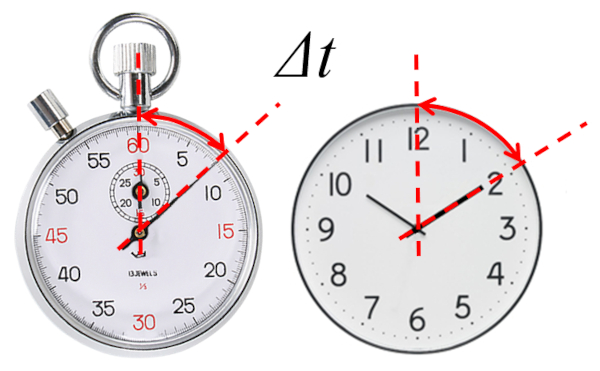
The stopwatch directly gives us the elapsed time since its initial time is zero
In the case of a stopwatch, the elapsed time is measured from the start of its measurement, i.e., a zero initial time ($t_0=0$).
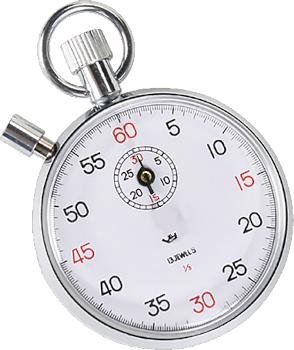
In the case of the clock, it is necessary to define the initial type in order to determine the elapsed time.
In the case of a clock, the elapsed time is measured from a defined initial time, which may or may not be zero.
Since the time elapsed ($\Delta t$) is calculated as the difference between the time ($t$) and the start Time ($t_0$):
| $ \Delta t \equiv t - t_0 $ |
it is possible to "shift" the time origin by adding a constant value
to both time points:
$t \rightarrow t + \tau$
$t_0 \rightarrow t_0 + \tau$
without affecting the elapsed time:
$\Delta t = t - t_0 \rightarrow (t + \tau) - (t_0 + \tau) = t - t_0 = \Delta t$
This property is known as temporal invariance, meaning that the elapsed time remains unchanged regardless of the specific starting point of the measurement.
Consequently, laws formulated using this principle will be temporally invariant, meaning they remain valid whether applied in the present, the past, or the future.
(ID 12507)
A situation that can arise is when the angular velocity is constant, which means that the angle covered increases proportionally to the elapsed time. In other words, using , this can be expressed as:
$\omega=\omega_0$
It is important to note that angular velocity is always measured relative to a reference frame. In this case, the constant angular velocity is with respect to the reference frame being used for measurement.
(ID 11410)
The average angular velocity is defined as the angle traversed in the elapsed time. As rotation requires an axis, it is drawn orthogonal to the disk that represents the rotating body. To integrate the axis, the angular velocity is defined as a vector in which the magnitude is the angle traversed per unit of time and the direction is defined based on the direction of the axis:
(ID 10967)
In the case of constant angular velocity and known initial time, the angle can be calculated using the following formula:
| $ \theta = \theta_0 + \omega_0 ( t - t_0 )$ |
The formula is graphically represented below:
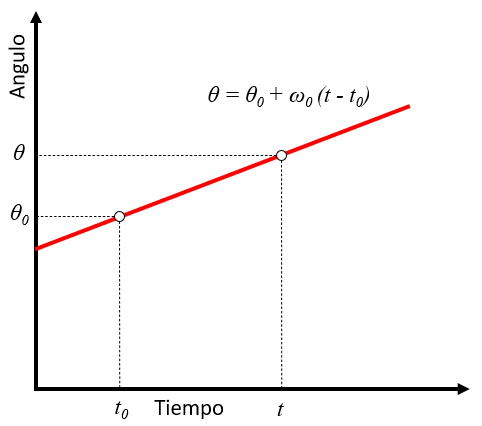
This formula is useful for calculating the angle rotated by an object in situations where both the angular velocity and initial time are known. The constancy of the angular velocity indicates that the magnitude of the angular velocity does not change with time. The initial time is the reference time from which the elapsed time is measured. Therefore, the angle rotated by the object can be calculated directly by multiplying the angular velocity by the elapsed time from the initial time.
(ID 11412)
If an object is subjected to a mode of maintaining a constant radius, it will rotate as indicated in the figure. Upon observing the figure, one would notice that the mass undergoes a translational motion with a tangential velocity that is equal to the radius times the angular velocity:
However, if the element connecting the object to the axis is cut, the object will continue to move tangentially in a straight line.
(ID 310)
The orientation of the tangential velocity can be obtained using the right-hand rule. If the fingers point towards the axis of rotation and then are curled towards the position vector (radius), the thumb will point in the direction of the tangential velocity:
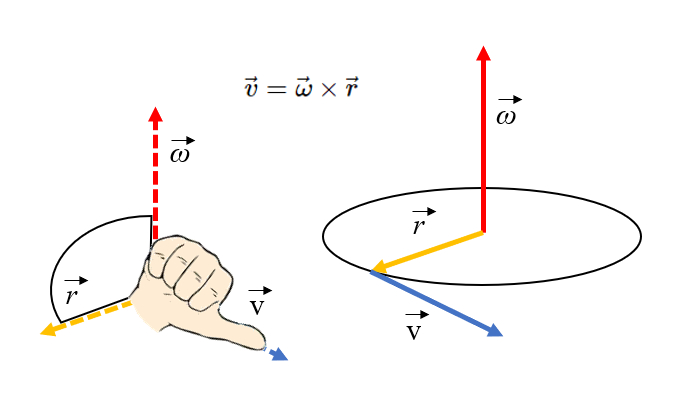
(ID 11599)
(ID 15420)
ID:(611, 0)