 User:
User:



A plate
Storyboard 
The geometry referred to as a plate can be described as an infinitely large plane that is electrically charged.

Variables

Calculations
 to
to  ,
then, select the variable:
,
then, select the variable:  to
to 
Calculations
Variable
 Given
Calculate
Given
Calculate
 Target :
Equation
To be used
Target :
Equation
To be used

Equations
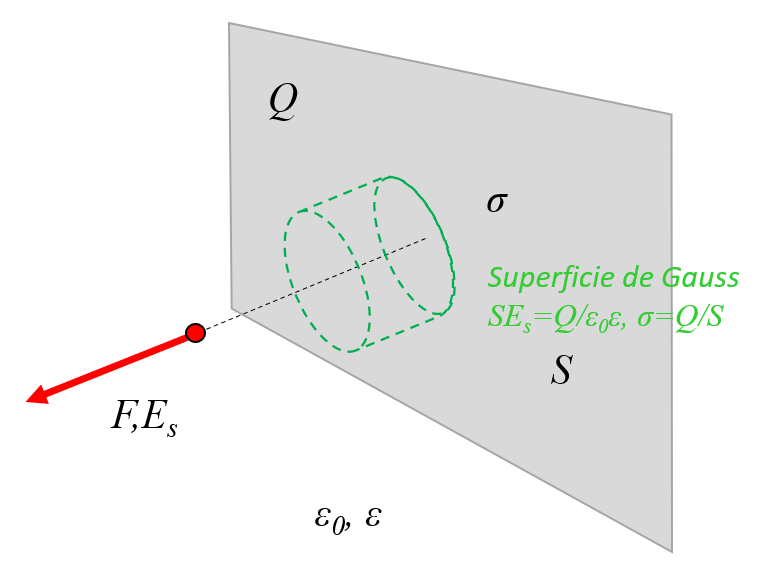
According to Gauss's Law, the variables the surface where the electric field is constant ($dS$), the charge ($Q$), the electric field constant ($\epsilon_0$), the dielectric constant ($\epsilon$), the versor normal to the section ($\hat{n}$), and the electric field ($\vec{E}$) satisfy the following equation:
In the case of a flat Gaussian surface, the field must be constant, so the relationship of the electric eield ($E$) with the surface of the conductor ($S$) is established as:
Since the charge density by area ($\sigma$) is equally defined by:
For the electric field of an infinite plate ($E_s$), the resulting expression is:
In the case of an infinite plate, the relationship between the electric potential, infinite plate ($\varphi_s$), the electric field of an infinite plate ($E_s$), and the position on the z axis ($z$) is established by the following equation:
Similarly, the relationship involving the electric field of an infinite plate ($E_s$), the electric field constant ($\epsilon_0$), the dielectric constant ($\epsilon$), and the charge density by area ($\sigma$) is defined as:
In spherical coordinates, this is expressed as:
$\varphi_s = -\displaystyle\int_0^z du \displaystyle\frac{ \sigma }{2 \epsilon_0 \epsilon }= -\displaystyle\frac{ \sigma }{2 \epsilon_0 \epsilon } z$
Finally, the relationship that includes the electric potential, infinite plate ($\varphi_s$) and the position on the z axis ($z$) is determined by the following equation:
In the case of an infinite plate, the relationship between the electric potential, infinite plate ($\varphi_s$), the electric field of an infinite plate ($E_s$), and the position on the z axis ($z$) is established by the following equation:
Similarly, the relationship involving the electric field of an infinite plate ($E_s$), the electric field constant ($\epsilon_0$), the dielectric constant ($\epsilon$), and the charge density by area ($\sigma$) is defined as:
In spherical coordinates, this is expressed as:
$\varphi_s = -\displaystyle\int_0^z du \displaystyle\frac{ \sigma }{2 \epsilon_0 \epsilon }= -\displaystyle\frac{ \sigma }{2 \epsilon_0 \epsilon } z$
Finally, the relationship that includes the electric potential, infinite plate ($\varphi_s$) and the position on the z axis ($z$) is determined by the following equation:

Examples
According to Gauss's Law, the variables the surface where the electric field is constant ($dS$), the charge ($Q$), the electric field constant ($\epsilon_0$), the dielectric constant ($\epsilon$), the versor normal to the section ($\hat{n}$), and the electric field ($\vec{E}$) satisfy the following equation:
In the case of a flat Gaussian surface, the field must be constant, so the relationship of the electric eield ($E$) with the surface of the conductor ($S$) is established as:
what is shown in the graph
Since the charge density by area ($\sigma$) is equally defined by:
For the electric field of an infinite plate ($E_s$), the resulting expression is:
The reference electrical, two infinity plates ($\varphi_d$) is with the electric field, two infinite plates ($E_d$) and the position on the z axis ($z$) is equal to:
the electric field of an infinite plate ($E_s$) is with the electric field constant ($\epsilon_0$), the dielectric constant ($\epsilon$) and the charge density by area ($\sigma$) is equal to:
the electric potential, infinite plate ($\varphi_s$) is with and the position on the z axis ($z$) turns out
As illustrated in the following graph:
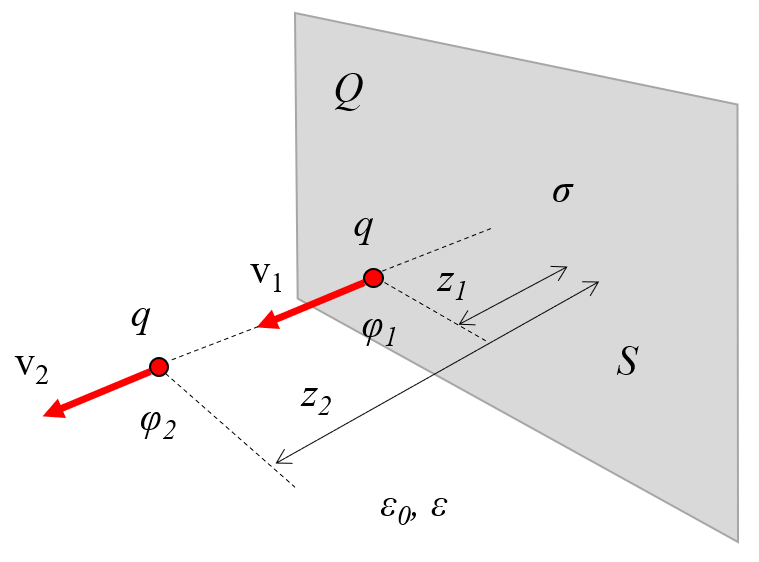
the field at two points must have the same energy. Therefore, the variables the charge ($Q$), the particle mass ($m$), the speed 1 ($v_1$), the speed 2 ($v_2$), and the electric potential 1 ($\varphi_1$) according to the equation:
and the electric potential 2 ($\varphi_2$), according to the equation:
must satisfy the following relationship:
The surface charge density is calculated by dividing the total charge by the surface area. Therefore, the relationship between the charge density by area ($\sigma$) and the charge ($Q$) with the surface of the conductor ($S$) is established as:
The electric field of an infinite plate ($E_s$) is with the electric field constant ($\epsilon_0$), the dielectric constant ($\epsilon$) and the charge density by area ($\sigma$) equal to:
The electric potential, infinite plate ($\varphi_s$) is with the electric field constant ($\epsilon_0$), the dielectric constant ($\epsilon$), the charge density by area ($\sigma$) and the position on the z axis ($z$) is equal to:
The electric potential, infinite plate ($\varphi_s$) is with the electric field constant ($\epsilon_0$), the dielectric constant ($\epsilon$), the charge density by area ($\sigma$) and the position on the z axis ($z$) is equal to:
Electric potentials, which represent potential energy per unit of charge, influence how the velocity of a particle varies. Consequently, due to the conservation of energy between two points, it follows that in the presence of variables the charge ($q$), the particle mass ($m$), the speed 1 ($v_1$), the speed 2 ($v_2$), the electric potential 1 ($\varphi_1$), and the electric potential 2 ($\varphi_2$), the following relationship must be satisfied:
ID:(2079, 0)