 User:
User:



Force of gravity and tides in opposition
Storyboard 
One of the accelerations that needs to be calculated is the one parallel to the ecliptic (in the Earth-celestial body plane) in opposition, meaning on the opposite side of the celestial body.
ID:(1575, 0)
Force of gravity and tides in opposition
Storyboard
One of the accelerations that needs to be calculated is the one parallel to the ecliptic (in the Earth-celestial body plane) in opposition, meaning on the opposite side of the celestial body.

Variables

Calculations
 to
to  ,
then, select the variable:
,
then, select the variable:  to
to 
Calculations
Variable
 Given
Calculate
Given
Calculate
 Target :
Equation
To be used
Target :
Equation
To be used

Equations

Examples
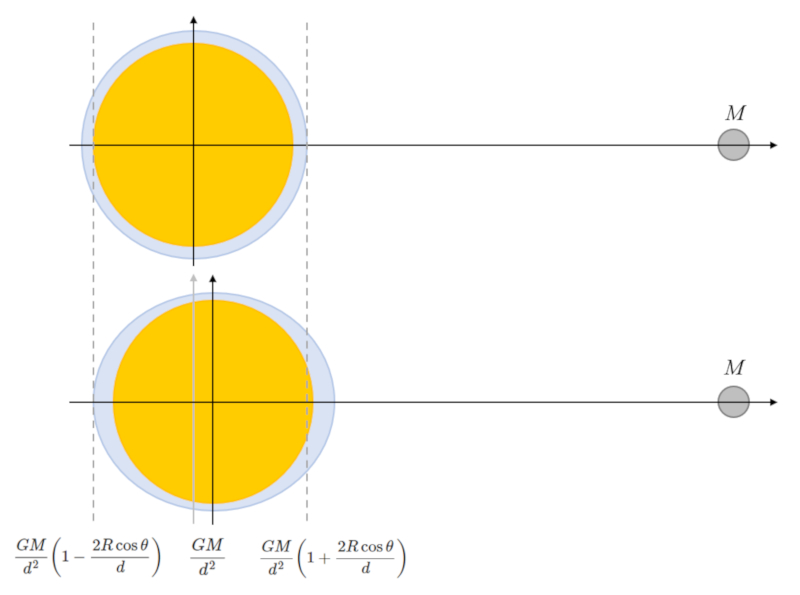
The attraction on the opposite side of the celestial body acting on Earth is weaker due to the greater distance. This facilitates water displacement towards the equator. On the side facing the celestial body, its gravitational attraction weakens Earth's gravitational acceleration, leading to a reduction in gravity that further aids water displacement towards the equator:
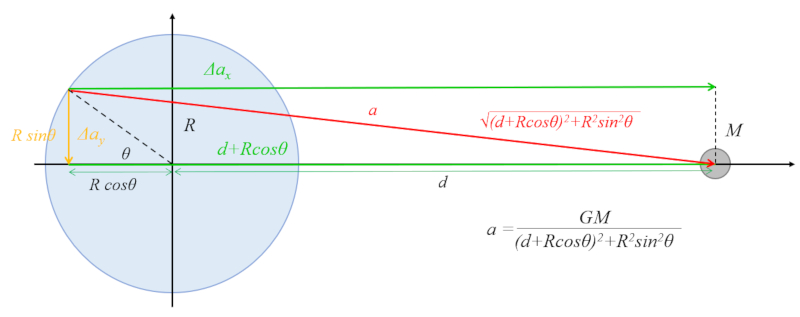
In this case, we work with similarity in the triangle, where we take the proportion
$\Delta a_{ox}/a_o$
and the leg
$d + R\cos\theta$
and the hypotenuse
$(d+R\cos\theta)^2+R^2\sin^2\theta=d^2+R^2+2dR\cos\theta$
There are multiple explanations for the tides on the opposite side of the celestial body. One of them is the effect of centrifugal acceleration due to the fact that the system rotates around the center of mass of the Earth-celestial body system, which is not at the center of the Earth. However, the values obtained for the case of the moon are very different on the side facing the moon compared to the opposite side of the Earth. Additionally, it would be difficult to explain the phenomenon in this way if the sun is taken as the celestial body since in that case the center of mass is near the center of the sun.
The simplest explanation that yields values like those observed is to assume that it is a problem of gravity differences and displacement of objects. Therefore:
• The tide toward the side of the celestial body originates from its attraction, which reduces the gravitational acceleration of the Earth.
• The tide on the opposite side of the celestial body occurs both due to the reduction of the celestial body's attraction and also because the Earth is displaced "within the water."
To determine the variation of acceleration along the radius, we can equate the relationship
$\displaystyle\frac{\Delta a_{ox}}{a_o}$
with the length
$d+R\cos\theta$
and the hypotenuse
$\sqrt{d^2+R^2+2dR\cos\theta}$
By similarity of triangles, we obtain with
With Newton's law of gravitation, represented by
,
we can define the force with
and the squared radius
$r^2=d^2+R^2+2dR\cos\theta$
,
to calculate the acceleration with
With
,
and with
thus
$\Delta a_{ox} =GM\displaystyle\frac{d + R\cos\theta}{(d^2 + R^2 + 2dR\cos\theta)^{3/2}}\sim \displaystyle\frac{GM}{d^2}\left(1-\displaystyle\frac{2R\cos\theta}{d}\right)$
,
so in the approximation
ID:(1575, 0)