
 User:
User:



Intercept at constant acceleration
Storyboard 
Objects can intersect when they coincide in position at the same moment. To achieve this, they must move from their respective starting points and velocities with accelerations that allow them to coincide in position and time at the end of the journey.
ID:(1412, 0)

Variation in speed and duration
Concept
In a scenario of motion involving two bodies, the first one alters its velocity by the speed difference of the first body ($\Delta v_1$) during ERROR:10256.1 with the first body acceleration ($a_1$).
| $ a_1 \equiv\displaystyle\frac{ \Delta v_1 }{ \Delta t_1 }$ |
Subsequently, the second body advances, altering its velocity by the second body speed difference ($\Delta v_2$) during a time span of the travel time of second object ($\Delta t_2$) with the second body acceleration ($a_2$).
| $ a_2 \equiv\displaystyle\frac{ \Delta v_2 }{ \Delta t_2 }$ |
When represented graphically, we obtain a velocity-time diagram as shown below:
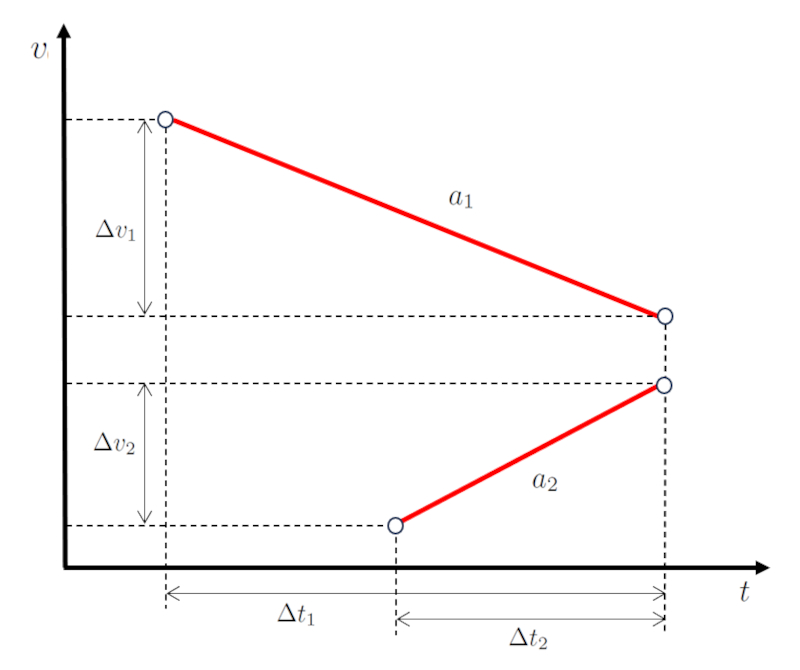
The key here is that the values the speed difference of the first body ($\Delta v_1$) and the second body speed difference ($\Delta v_2$), and the values the travel time of first object ($\Delta t_1$) and the travel time of second object ($\Delta t_2$), are such that both bodies coincide in place and time.
ID:(12512, 0)
Speed and intersection times
Concept
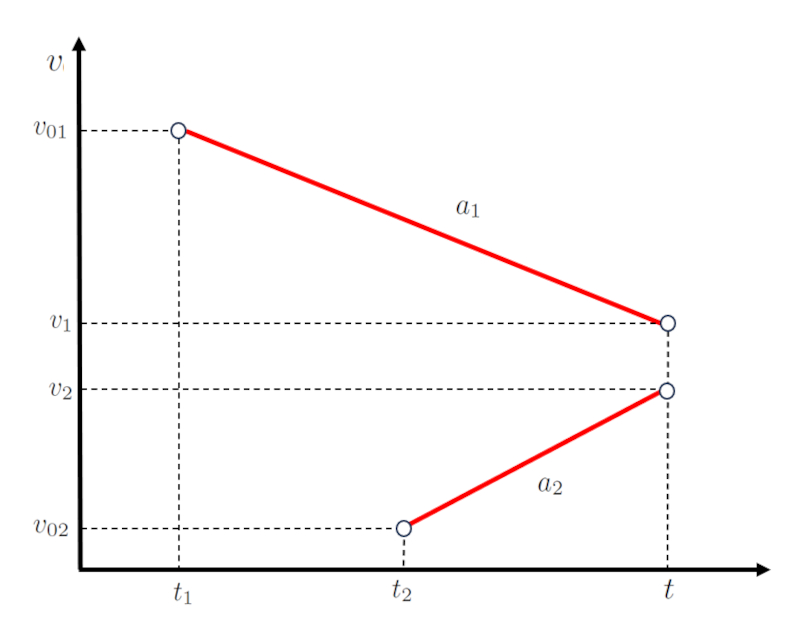
In the case of two bodies, the motion of the first one can be described by a function involving the points the initial time of first object ($t_1$), the intersection time ($t$), the initial velocity of the first body ($v_{01}$), and the final velocity of the first body ($v_1$), represented by a line with a slope of the first body acceleration ($a_1$):
| $ v_1 = v_{01} + a_1 ( t - t_1 )$ |
For the motion of the second body, defined by the points the initial velocity of the second body ($v_{02}$), the final velocity of the second body ($v_2$), the initial time of second object ($t_2$), and the intersection time ($t$), a second line with a slope of the second body acceleration ($a_2$) is employed:
| $ v_2 = v_{02} + a_2 ( t - t_2 )$ |
This is represented as:
ID:(12515, 0)
Evolution of the position of the bodies
Concept
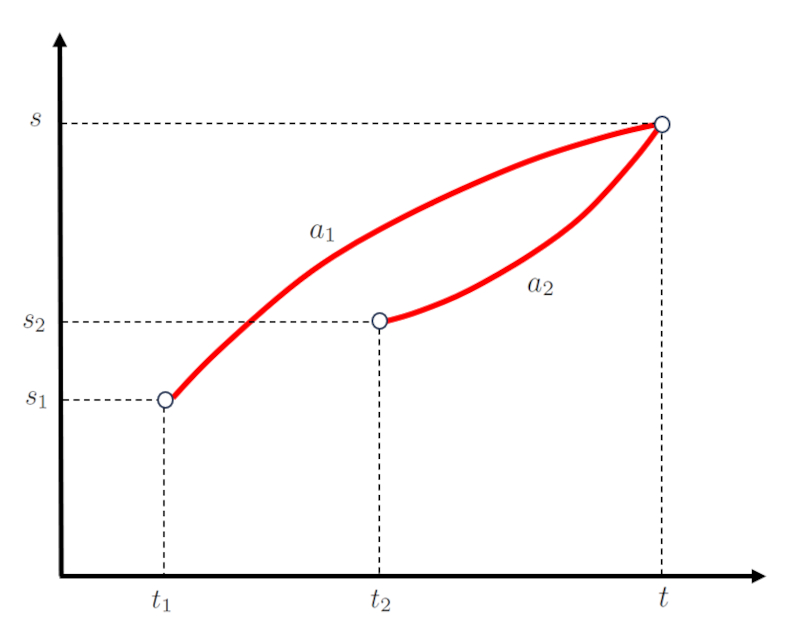
In the case of a two-body motion, the position where the trajectory of the first body ends coincides with that of the second body at the intersection position ($s$).
Similarly, the time at which the trajectory of the first body ends coincides with that of the second body at the intersection time ($t$).
For the first body, the intersection position ($s$) depends on the initial position of first object ($s_1$), the initial velocity of the first body ($v_{01}$), the first body acceleration ($a_1$), the initial time of first object ($t_1$), as follows:
| $ s = s_1 + v_{01} ( t - t_1 )+\displaystyle\frac{1}{2} a_1 ( t - t_1 )^2$ |
While for the second body, the intersection position ($s$) depends on the initial position of second object ($s_2$), the initial velocity of the second body ($v_{02}$), the second body acceleration ($a_2$), the initial time of second object ($t_2$), as follows:
| $ s = s_2 + v_{02} ( t - t_2 )+\displaystyle\frac{1}{2} a_2 ( t - t_2 )^2$ |
This is represented as:
ID:(12513, 0)
Intercept at constant acceleration
Model
Objects can intersect when they coincide in position at the same moment. To achieve this, they must move from their respective starting points and velocities with accelerations that allow them to coincide in position and time at the end of the journey.

Variables

Calculations
 to
to  ,
then, select the variable:
,
then, select the variable:  to
to 
Calculations
Variable
 Given
Calculate
Given
Calculate
 Target :
Equation
To be used
Target :
Equation
To be used

Equations
In the case where the constant Acceleration ($a_0$) equals the mean Acceleration ($\bar{a}$), it will be equal to
| $ a_0 = \bar{a} $ |
.
Therefore, considering the speed Diference ($\Delta v$) as
| $ dv \equiv v - v_0 $ |
and the time elapsed ($\Delta t$) as
| $ \Delta t \equiv t - t_0 $ |
,
the equation for the constant Acceleration ($a_0$)
| $ \bar{a} \equiv\displaystyle\frac{ \Delta v }{ \Delta t }$ |
can be written as
$a_0 = \bar{a} = \displaystyle\frac{\Delta v}{\Delta t} = \displaystyle\frac{v - v_0}{t - t_0}$
and by rearranging, we obtain
| $ v = v_0 + a_0 ( t - t_0 )$ |
.
(ID 3156)
In the case where the constant Acceleration ($a_0$) equals the mean Acceleration ($\bar{a}$), it will be equal to
| $ a_0 = \bar{a} $ |
.
Therefore, considering the speed Diference ($\Delta v$) as
| $ dv \equiv v - v_0 $ |
and the time elapsed ($\Delta t$) as
| $ \Delta t \equiv t - t_0 $ |
,
the equation for the constant Acceleration ($a_0$)
| $ \bar{a} \equiv\displaystyle\frac{ \Delta v }{ \Delta t }$ |
can be written as
$a_0 = \bar{a} = \displaystyle\frac{\Delta v}{\Delta t} = \displaystyle\frac{v - v_0}{t - t_0}$
and by rearranging, we obtain
| $ v = v_0 + a_0 ( t - t_0 )$ |
.
(ID 3156)
In the case of the constant Acceleration ($a_0$), the speed ($v$) as a function of the time ($t$) forms a straight line passing through the start Time ($t_0$) and the initial Speed ($v_0$), defined by the equation:
| $ v = v_0 + a_0 ( t - t_0 )$ |
Since the distance traveled in a time ($\Delta s$) represents the area under the velocity-time curve, we can sum the contributions of the rectangle:
$v_0(t-t_0)$
and the triangle:
$\displaystyle\frac{1}{2}a_0(t-t_0)^2$
To obtain the distance traveled in a time ($\Delta s$) with the position ($s$) and the starting position ($s_0$), resulting in:
| $ \Delta s = s - s_0 $ |
Therefore:
| $ s = s_0 + v_0 ( t - t_0 )+\displaystyle\frac{1}{2} a_0 ( t - t_0 )^2$ |
(ID 3157)
In the case of the constant Acceleration ($a_0$), the speed ($v$) as a function of the time ($t$) forms a straight line passing through the start Time ($t_0$) and the initial Speed ($v_0$), defined by the equation:
| $ v = v_0 + a_0 ( t - t_0 )$ |
Since the distance traveled in a time ($\Delta s$) represents the area under the velocity-time curve, we can sum the contributions of the rectangle:
$v_0(t-t_0)$
and the triangle:
$\displaystyle\frac{1}{2}a_0(t-t_0)^2$
To obtain the distance traveled in a time ($\Delta s$) with the position ($s$) and the starting position ($s_0$), resulting in:
| $ \Delta s = s - s_0 $ |
Therefore:
| $ s = s_0 + v_0 ( t - t_0 )+\displaystyle\frac{1}{2} a_0 ( t - t_0 )^2$ |
(ID 3157)
If we solve for the time ($t$) and the start Time ($t_0$) in the equation of the speed ($v$), which depends on the initial Speed ($v_0$) and the constant Acceleration ($a_0$):
| $ v = v_0 + a_0 ( t - t_0 )$ |
we get:
$t - t_0= \displaystyle\frac{v - v_0}{a_0}$
And when we substitute this into the equation of the position ($s$) with the starting position ($s_0$):
| $ s = s_0 + v_0 ( t - t_0 )+\displaystyle\frac{1}{2} a_0 ( t - t_0 )^2$ |
we obtain an expression for the distance traveled as a function of velocity:
| $ s = s_0 +\displaystyle\frac{ v ^2- v_0 ^2}{2 a_0 }$ |
(ID 3158)
If we solve for the time ($t$) and the start Time ($t_0$) in the equation of the speed ($v$), which depends on the initial Speed ($v_0$) and the constant Acceleration ($a_0$):
| $ v = v_0 + a_0 ( t - t_0 )$ |
we get:
$t - t_0= \displaystyle\frac{v - v_0}{a_0}$
And when we substitute this into the equation of the position ($s$) with the starting position ($s_0$):
| $ s = s_0 + v_0 ( t - t_0 )+\displaystyle\frac{1}{2} a_0 ( t - t_0 )^2$ |
we obtain an expression for the distance traveled as a function of velocity:
| $ s = s_0 +\displaystyle\frac{ v ^2- v_0 ^2}{2 a_0 }$ |
(ID 3158)
The definition of the mean Acceleration ($\bar{a}$) is considered as the relationship between the speed Diference ($\Delta v$) and the time elapsed ($\Delta t$). That is,
| $ dv \equiv v - v_0 $ |
and
| $ \Delta t \equiv t - t_0 $ |
The relationship between both is defined as the centrifuge Acceleration ($a_c$)
| $ \bar{a} \equiv\displaystyle\frac{ \Delta v }{ \Delta t }$ |
within this time interval.
(ID 3678)
The definition of the mean Acceleration ($\bar{a}$) is considered as the relationship between the speed Diference ($\Delta v$) and the time elapsed ($\Delta t$). That is,
| $ dv \equiv v - v_0 $ |
and
| $ \Delta t \equiv t - t_0 $ |
The relationship between both is defined as the centrifuge Acceleration ($a_c$)
| $ \bar{a} \equiv\displaystyle\frac{ \Delta v }{ \Delta t }$ |
within this time interval.
(ID 3678)
If we start from the starting position ($s_0$) and want to calculate the distance traveled in a time ($\Delta s$), we need to define a value for the position ($s$).
In a one-dimensional system, the distance traveled in a time ($\Delta s$) is simply obtained by subtracting the starting position ($s_0$) from the position ($s$), resulting in:
| $ \Delta s = s - s_0 $ |
(ID 4352)
If we start from the starting position ($s_0$) and want to calculate the distance traveled in a time ($\Delta s$), we need to define a value for the position ($s$).
In a one-dimensional system, the distance traveled in a time ($\Delta s$) is simply obtained by subtracting the starting position ($s_0$) from the position ($s$), resulting in:
| $ \Delta s = s - s_0 $ |
(ID 4352)
(ID 4355)
(ID 4355)

Examples
(ID 15399)
In a scenario of motion involving two bodies, the first one alters its velocity by the speed difference of the first body ($\Delta v_1$) during ERROR:10256.1 with the first body acceleration ($a_1$).
| $ a_1 \equiv\displaystyle\frac{ \Delta v_1 }{ \Delta t_1 }$ |
Subsequently, the second body advances, altering its velocity by the second body speed difference ($\Delta v_2$) during a time span of the travel time of second object ($\Delta t_2$) with the second body acceleration ($a_2$).
| $ a_2 \equiv\displaystyle\frac{ \Delta v_2 }{ \Delta t_2 }$ |
When represented graphically, we obtain a velocity-time diagram as shown below:
The key here is that the values the speed difference of the first body ($\Delta v_1$) and the second body speed difference ($\Delta v_2$), and the values the travel time of first object ($\Delta t_1$) and the travel time of second object ($\Delta t_2$), are such that both bodies coincide in place and time.
(ID 12512)
In the case of two bodies, the motion of the first one can be described by a function involving the points the initial time of first object ($t_1$), the intersection time ($t$), the initial velocity of the first body ($v_{01}$), and the final velocity of the first body ($v_1$), represented by a line with a slope of the first body acceleration ($a_1$):
| $ v_1 = v_{01} + a_1 ( t - t_1 )$ |
For the motion of the second body, defined by the points the initial velocity of the second body ($v_{02}$), the final velocity of the second body ($v_2$), the initial time of second object ($t_2$), and the intersection time ($t$), a second line with a slope of the second body acceleration ($a_2$) is employed:
| $ v_2 = v_{02} + a_2 ( t - t_2 )$ |
This is represented as:
(ID 12515)
In the case of a two-body motion, the position where the trajectory of the first body ends coincides with that of the second body at the intersection position ($s$).
Similarly, the time at which the trajectory of the first body ends coincides with that of the second body at the intersection time ($t$).
For the first body, the intersection position ($s$) depends on the initial position of first object ($s_1$), the initial velocity of the first body ($v_{01}$), the first body acceleration ($a_1$), the initial time of first object ($t_1$), as follows:
| $ s = s_1 + v_{01} ( t - t_1 )+\displaystyle\frac{1}{2} a_1 ( t - t_1 )^2$ |
While for the second body, the intersection position ($s$) depends on the initial position of second object ($s_2$), the initial velocity of the second body ($v_{02}$), the second body acceleration ($a_2$), the initial time of second object ($t_2$), as follows:
| $ s = s_2 + v_{02} ( t - t_2 )+\displaystyle\frac{1}{2} a_2 ( t - t_2 )^2$ |
This is represented as:
(ID 12513)
(ID 15402)
ID:(1412, 0)