 User:
User:



Absorption, dispersion and sound sources
Storyboard 
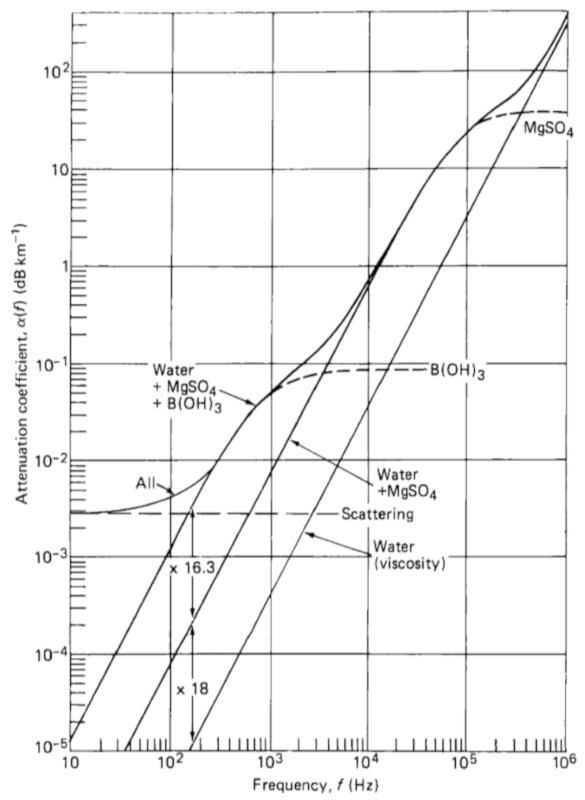
The attenuation of sound waves in the ocean depends on the frequency of the sound. For low frequencies (below 10 kHz), the main contribution comes from boric acid ions, while in the range between 10 kHz and 100 kHz, it is due to the effect of magnesium sulfate ions. For higher frequencies, attenuation is primarily due to the viscosity of the water.
ID:(1549, 0)
Absorption, dispersion and sound sources
Storyboard
The attenuation of sound waves in the ocean depends on the frequency of the sound. For low frequencies (below 10 kHz), the main contribution comes from boric acid ions, while in the range between 10 kHz and 100 kHz, it is due to the effect of magnesium sulfate ions. For higher frequencies, attenuation is primarily due to the viscosity of the water.

Variables

Calculations
 to
to  ,
then, select the variable:
,
then, select the variable:  to
to 
Calculations
Variable
 Given
Calculate
Given
Calculate
 Target :
Equation
To be used
Target :
Equation
To be used

Equations

Examples
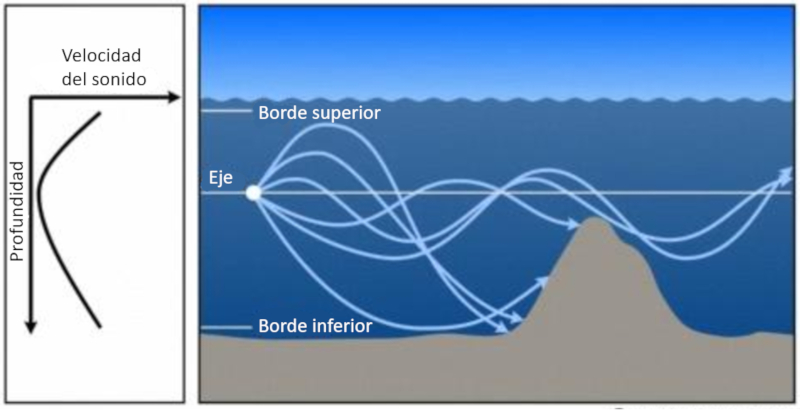
Slopes in the background lead to disturbances in sound propagation:
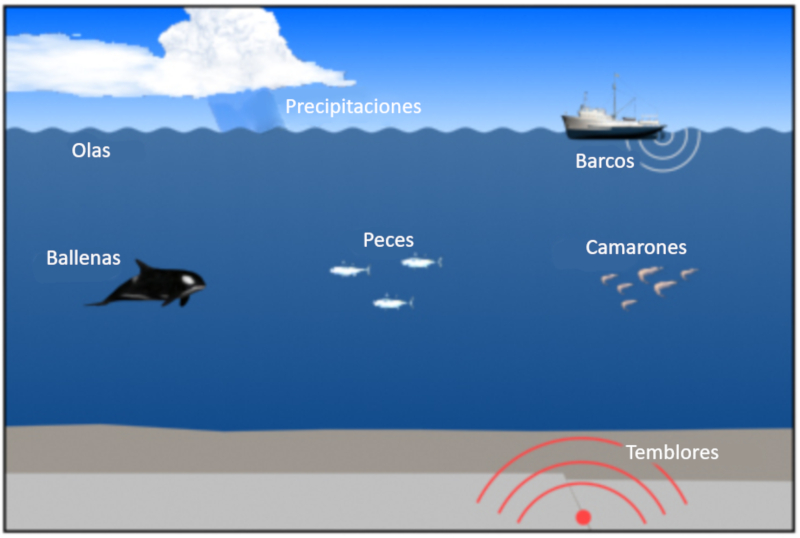
There are different sources of sound in the oceans. Among them are
• human sources (first of all ships)
• rain on the surface
• fish, shrimp, whales, etc.
• waves
• tremors
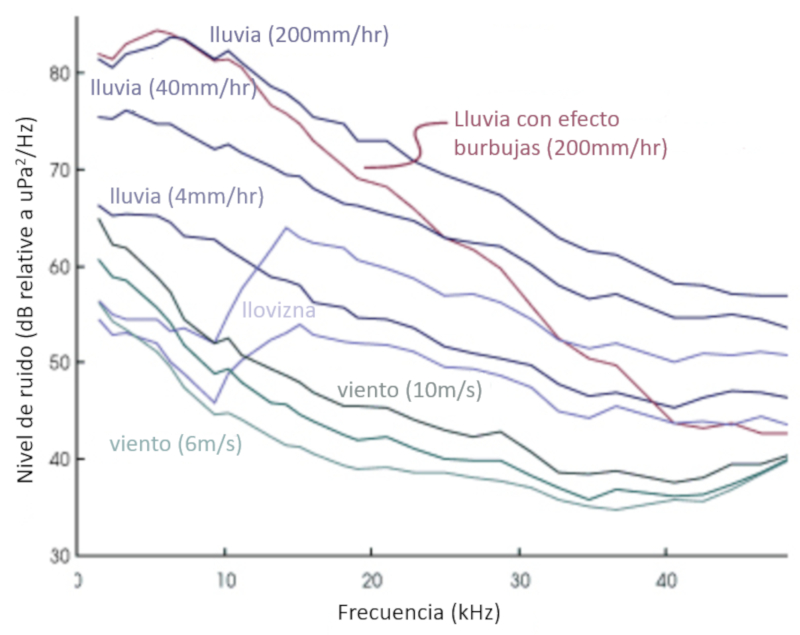
The spectra of the sources, which correspond to the measurement of the amplitudes of the sound according to their frequency, show the strong presence of the rains:
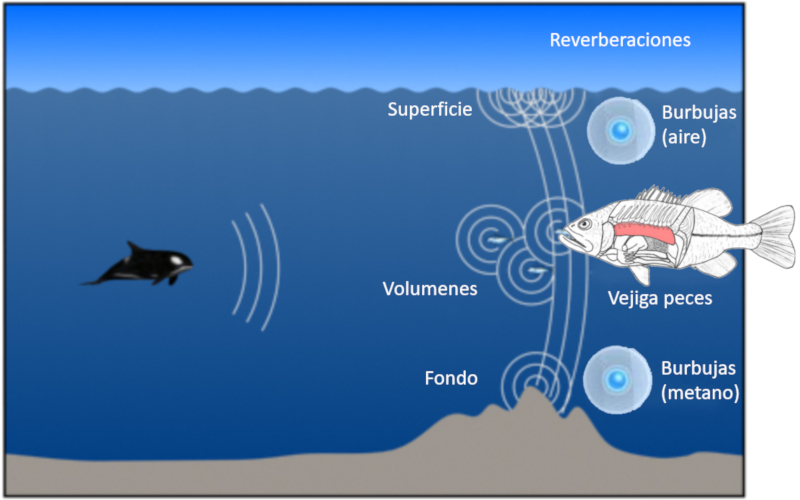
The sound emitted can generate that some elements in turn begin to generate sound. Two relevant examples in the case of the oceans are:
- air bubbles generated by waves when bursting
- methane bubbles generated when organic matter decomposes
- fish bladders:
There are three mechanisms that attenuate sound in the sea:
• magnesium sulfate ion relaxations (up to 10kHz)
• Boric acid ion relaxations (up to 100kHz)
• water viscosity (at all frequencies)
El factor de absorci n indica como la energ a se va perdido a lo largo del camino recorrido. Como la perdida es siempre proporcional a la intensidad existente se tiene un decaimiento exponencial.
Por ello con
Existe una amortiguaci n del sonido en agua de mar por efecto de interacci n de mol culas con los iones de hidr xido (OH-) o con mol culas de agua. Esto se denomina procesos de relajaci n y ocurren en el agua de mar principalmente con:
• mol culas de agua entre estas
• cido b rico que interactua con los iones de hidr xido $OH^-$s: $B(OH)_3\cdot OH^- \rightleftharpoons B(OH)_4$
• sulfato de magnesio que interactua con mol culas de agua $H_2O$: $MgSO_4 + 2nH_2O \rightleftharpoons Mg^{2+}nH_2O + SO_4^{-2}nH_2O$
Los tiempos de relajamiento y sus frecuencias son del orden de
| Componente | Tiempo de relajamiento | Frecuencia |
| Agua | $10^{-11}s$ | $10^5,MHz$ |
| cido b rico | $10^{-3}s$ | $1,kHz$ |
| Sulfato de magnesio (1) | $10^{-5}s$ | $100,kHz$ |
| Sulfato de magnesio (2) | $2\times 10^{-8}s$ | $200,kHz$ |
Sobre esta base se estima el factor de absorci n en funci n de la frecuencia y suponiendo pH t pico:
Existe una amortiguaci n del sonido en agua de mar por efecto de interacci n de mol culas con los iones de hidr xido (OH-) o con mol culas de agua. Esto se denomina procesos de relajaci n y ocurren en el agua de mar principalmente con:
• mol culas de agua entre estas
• cido b rico que interactua con los iones de hidr xido $OH^-$s: $B(OH)_3\cdot OH^- \rightleftharpoons B(OH)_4$
• sulfato de magnesio que interactua con mol culas de agua $H_2O$: $MgSO_4 + 2nH_2O \rightleftharpoons Mg^{2+}nH_2O + SO_4^{-2}nH_2O$
Los tiempos de relajamiento y sus frecuencias son del orden de
| Componente | Tiempo de relajamiento | Frecuencia |
| Agua | $10^{-11}s$ | $10^5,MHz$ |
| cido b rico | $10^{-3}s$ | $1,kHz$ |
| Sulfato de magnesio (1) | $10^{-5}s$ | $100,kHz$ |
| Sulfato de magnesio (2) | $2\times 10^{-8}s$ | $200,kHz$ |
Sobre esta base se estima el factor de absorci n en funci n de la frecuencia y suponiendo pH t pico es con
En este caso el primer termino es el que depende del cido b rico, el segundo del sulfato de magnesio y el tercero de la ionizaci n propia del agua. Ademas se puede comentar que no existe un efecto por la salinidad (no hay relajaci n por iones de sodio y/o cloro).
Mas detalles en el articulo Study of Absorption Loss Effects on Acoustic Wave Propagation in Shallow Water using Different empirical Models, Yasin Yousif Al-Aboosil, Mustafa Sami Ahmed, Nor Shahida Mohd Shah and Nor Hisham Haji Khamis
ID:(1549, 0)