 User:
User:



Solar radiation
Storyboard 
The origin of the weather is the sun. Its energy reaches the earth by heating in a different way atmosphere and surface creating gradients that are balanced by conduction, convection and winds.
Therefore, the power of the sun must be studied, how it reaches the earth and how it is distributed over the earth's surface.
ID:(534, 0)
Solar radiation
Storyboard
The origin of the weather is the sun. Its energy reaches the earth by heating in a different way atmosphere and surface creating gradients that are balanced by conduction, convection and winds. Therefore, the power of the sun must be studied, how it reaches the earth and how it is distributed over the earth's surface.

Variables

Calculations
 to
to  ,
then, select the variable:
,
then, select the variable:  to
to 
Calculations
Variable
 Given
Calculate
Given
Calculate
 Target :
Equation
To be used
Target :
Equation
To be used

Equations
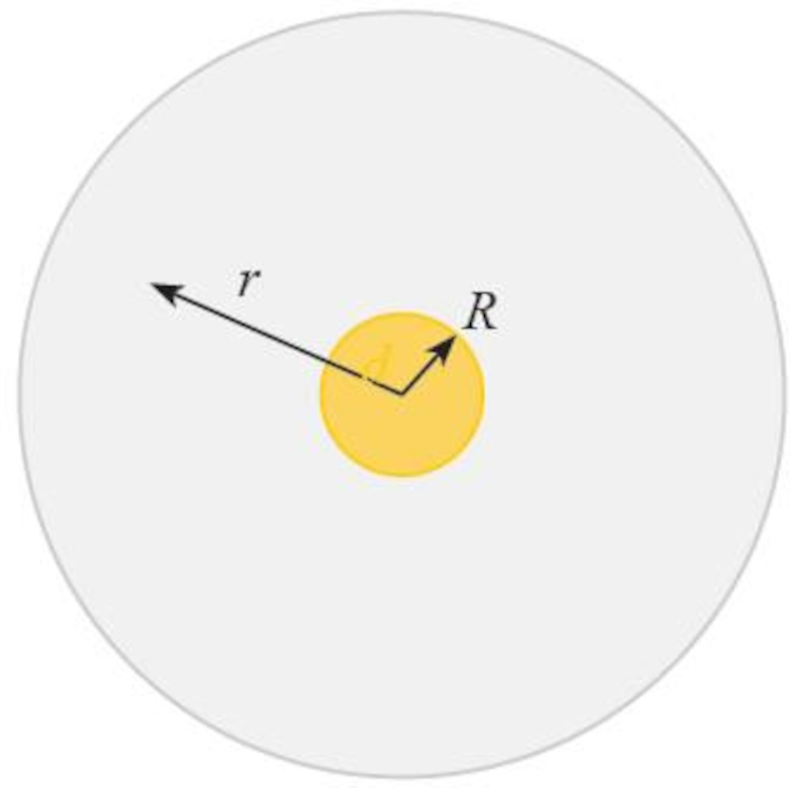
The intensity ($I$) is defined as the power ($P$) per unit of the surface of a sphere ($S$):
If we consider an imaginary sphere with ERROR:6490,0, we can calculate its surface:
This allows us to obtain the intensity ($I$):
The intensity ($I$) is defined as the power ($P$) per unit of the surface of a sphere ($S$):
If we consider an imaginary sphere with ERROR:6490,0, we can calculate its surface:
This allows us to obtain the intensity ($I$):
The intensity ($I$) is defined as the power ($P$) per unit of the surface of a sphere ($S$):
If we consider an imaginary sphere with ERROR:6490,0, we can calculate its surface:
This allows us to obtain the intensity ($I$):
If we replace the sun power ($P_s$) of the sun, calculated as the radiation intensity on the sun's surface ($I_s$) on the surface of a sphere with a radius of ERROR:6492,0:
into the equation for the intensity at orbit distance ($I_r$) of sunlight at the distance earth sun ($r$):
we can obtain the relationship between intensities:
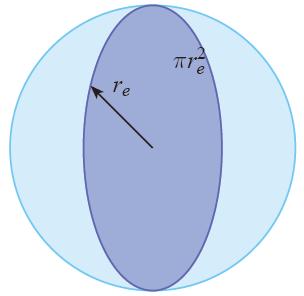
Given that the intensity ($I$) is the power ($P$) captured by the surface of a sphere ($S$) according to:
and that the surface of a disk ($S$) is the area of the disk of the disc radius ($r$), which is equal to:
we have:

Examples
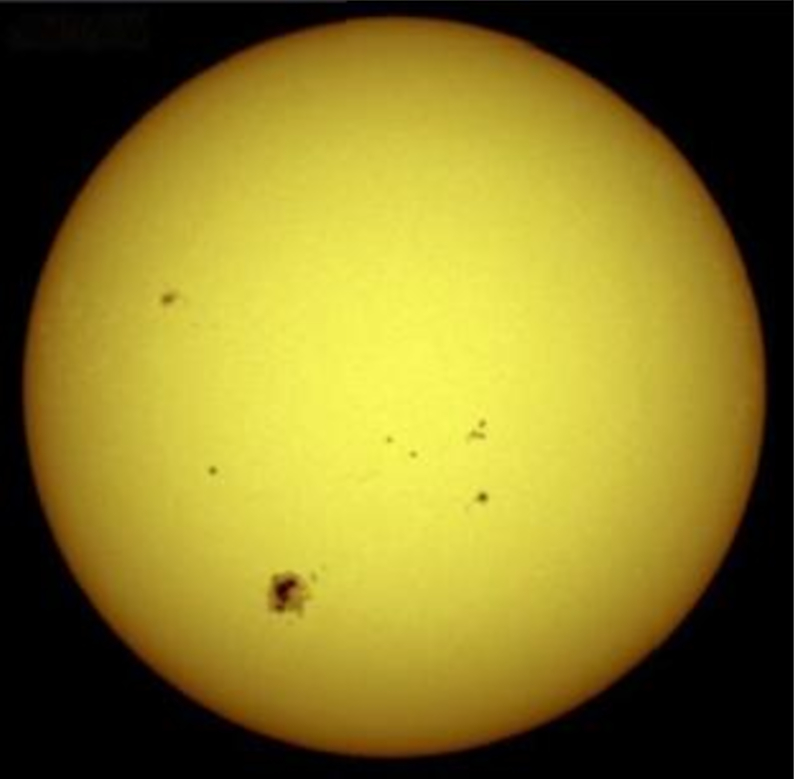
The source of energy that defines the Earth's climate is the sun.
The key parameters of the sun are:
| Parameter | Variable | Value |
| Radius | $R$ | 696342 km |
| Surface Area | $S$ | 6.09E+12 km2 |
| Mass | $M$ | 1.98855E+30 kg |
| Density | $\rho$ | 1.408 g/cm2 |
| Surface Temperature | $T_s$ | 5778 K |
| Power | $P$ | 3.846E+26 W |
| Intensity | $I$ | 6.24E+7 W/m2 |
The planet Earth, shown in the following image:
has the following characteristics:
| Parameter | Symbol | Value |
| Distance from the sun | $r$ | 1.496E+8 km |
| Radius | $R$ | 6371.0 km |
| Mass | $M$ | 5.972E+24 kg |
| Orbit period | $T_o$ | 365 days |
| Rotation period | $T_r$ | 24 hours |
| Eccentricity | $\epsilon$ | 0.017 |
| Axis inclination | $\phi$ | 23.44 |
Below are the images of the different planets, in order: Mercury, Venus, Earth, Mars, Jupiter, Saturn, Uranus, Neptune, and Pluto:
The different planets have a variety of radii, masses, orbital and rotational periods, axial tilts, and distances from the sun, summarized as follows:
| Planet | Radius* | Mass* | Distance from Sun* | Orbital Period* | Rotation Period* | Eccentricity | Axial Tilt |
| Mercury | 0.382 | 0.06 | 0.39 | 0.24 | 58.64 | 0.206 | 0.04 |
| Venus | 0.949 | 0.82 | 0.72 | 0.62 | -243.02 | 0.007 | 177.36 |
| Earth | 1.000 | 1.00 | 1.00 | 1.00 | 1.00 | 0.017 | 23.44 |
| Mars | 0.532 | 0.11 | 1.52 | 1.88 | 1.03 | 0.093 | 25.19 |
| Jupiter | 11.209 | 317.8 | 5.2 | 11.86 | 0.41 | 0.048 | 3.13 |
| Saturn | 9.449 | 95.2 | 9.54 | 29.46 | 0.43 | 0.054 | 26.73 |
| Uranus | 4.007 | 14.6 | 19.22 | 84.01 | -0.72 | 0.047 | 97.77 |
| Neptune | 3.883 | 17.2 | 30.06 | 164.8 | 0.67 | 0.0009 | 28.32 |
| Pluto | 0.186 | 0.0022 | 39.482 | 247.94 | 1.005 | 0.2488 | 17.16 |
* data in proportion to Earth's value
The radiation intensity on the sun's surface ($I_s$) is defined as the sun power ($P_s$) per unit of the surface of the sun ($S_s$), where the power is represented by:
If we model the sun as a sphere with the sun Radio ($R_s$), its surface area is:
Therefore, the radiation intensity on the sun's surface ($I_s$) is calculated as:
The intensity at orbit distance ($I_r$) is defined as the sun power ($P_s$) per unit of the sphere surface in orbit ($S_r$):
If we consider an imaginary sphere with a radius equal to the distance between the sun and the Earth, ERROR:10360,0, we can calculate its cross-sectional area:
This allows us to obtain the intensity at orbit distance ($I_r$):
The Sun's radiation propagates through its surface, which has an area of $4\pi R_s^2$ with a sun Radio ($R_s$) as the Sun's radius, and it is distributed at the distance of Earth's orbit, which has a surface area equal to $4\pi r^2$ with a distance earth sun ($r$) as the distance between the Earth and the Sun:
If we replace the sun power ($P_s$) of the sun, calculated as the radiation intensity on the sun's surface ($I_s$) on the surface of a sphere with a radius of ERROR:6492,0:
into the equation for the intensity at orbit distance ($I_r$) of sunlight at the distance earth sun ($r$):
we can obtain the relationship between intensities:
Given that the intensity at orbit distance ($I_r$) reaching the Earth is equal to the power captured by the earth ($P_d$) captured by the section presenting the planet ($S_d$) according to:
and that the section presenting the planet ($S_d$) of the disk of the planet radius ($R_p$) is equal to:
we have:
The average earth intensity ($I_p$) over the entire surface of the planet radius ($R_p$) is equal to the intensity at orbit distance ($I_r$) captured by a disk of the planet radius ($R_p$), therefore:
$4\pi R_p^2 I_s = \pi R_p^2 I_p$
Therefore, it follows that:
The intensity ($I$) is defined as the amount of the power ($P$) irradiated per unit of the surface of a sphere ($S$). Therefore, the following relationship is established:
The intensity ($I$) is defined as the amount of the power ($P$) irradiated per unit of the surface of a sphere ($S$). Therefore, the following relationship is established:
The intensity ($I$) is defined as the amount of the power ($P$) irradiated per unit of the surface of a sphere ($S$). Therefore, the following relationship is established:
The intensity ($I$) is defined as the amount of the power ($P$) irradiated per unit of the surface of a sphere ($S$). Therefore, the following relationship is established:
The surface of a sphere ($S$) of a radius of a sphere ($r$) can be calculated using the following formula:
The surface of a sphere ($S$) of a radius of a sphere ($r$) can be calculated using the following formula:
The surface of a sphere ($S$) of a radius of a sphere ($r$) can be calculated using the following formula:
The surface of a disk ($S$) of ERROR:5275.1 is calculated as follows:
The ratio between the intensity at orbit distance ($I_r$) and the radiation intensity on the sun's surface ($I_s$) is equal to the ratio of the surface area of a sphere with a radius of the sun Radio ($R_s$) to the surface area of a sphere with a radius of the distance earth sun ($r$), therefore it is:
The average earth intensity ($I_p$) is equal to one-fourth of the intensity at orbit distance ($I_r$) because the surface area of the emitting sphere is four times larger than that of the capturing disk. Therefore:
ID:(534, 0)