
 User:
User:



Example of the Random Path (Rando Walk)
Storyboard 
The random path is a typical example as starting from microscopic probabilities (the step to the right or left) it is possible to develop a probability distribution that accounts for the most probable places in which the walker can be found.
ID:(308, 0)

Random walk problem
Image
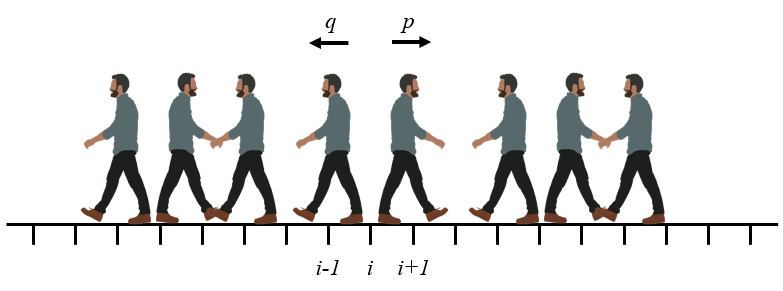
The problem of the random path is an example of how one can from the microscopic description predict the probable temporal evolution. In this case it is assumed that an actor (particle, person, etc.) randomly chooses whether to take a step to the right or to the left. It is assumed that the steps have a length
ID:(11396, 0)
Binomial distribution
Image
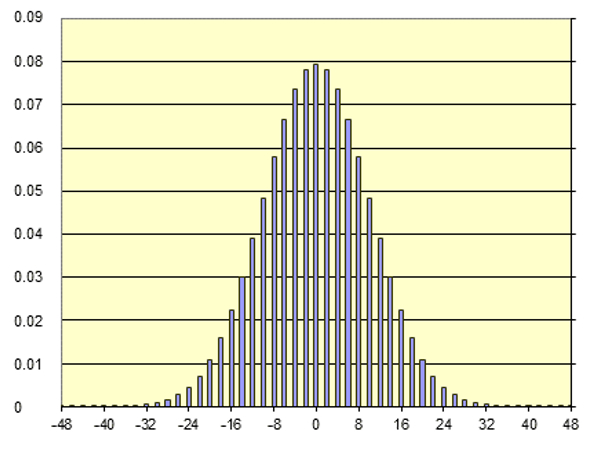
The result of the calculation corresponds to what is called a binomial distribution. Each line indicates the fraction of times that after a number
ID:(11397, 0)

Example of the Random Path (Rando Walk)
Model
The random path is a typical example as starting from microscopic probabilities (the step to the right or left) it is possible to develop a probability distribution that accounts for the most probable places in which the walker can be found.

Variables

Calculations
 to
to  ,
then, select the variable:
,
then, select the variable:  to
to 
Calculations
Variable
 Given
Calculate
Given
Calculate
 Target :
Equation
To be used
Target :
Equation
To be used

Equations
(ID 501)
(ID 503)
(ID 3358)
(ID 8965)

Examples
The problem of the random path is an example of how one can from the microscopic description predict the probable temporal evolution. In this case it is assumed that an actor (particle, person, etc.) randomly chooses whether to take a step to the right or to the left. It is assumed that the steps have a length
(ID 11396)
The result of the calculation corresponds to what is called a binomial distribution. Each line indicates the fraction of times that after a number
(ID 11397)
ID:(308, 0)