
 User:
User:



Generalized Force
Storyboard 
The generalized forces (intensive variables) and their corresponding conjugate variables (extensive variables) represent how various microscopic parameters can be calculated from microscopic distributions.
ID:(438, 0)

Examples of intensive and extensive variables
Image
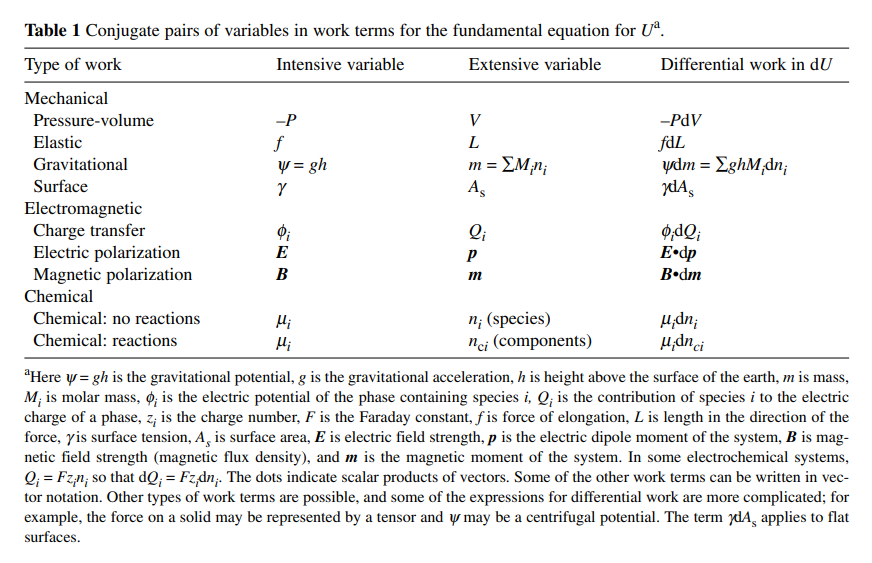
An article that summarizes most of the thermodynamic relationships very well is Use of Legendre Transforms in Chemical Thermodynamics, Robert A. Alberty, Pure Appl. Chem., Vol. 73, No. 8, pp. 13491380, 2001 containing the following table of pairs of extensive and intensive variables:
ID:(11545, 0)

Generalized Force
Model
The generalized forces (intensive variables) and their corresponding conjugate variables (extensive variables) represent how various microscopic parameters can be calculated from microscopic distributions.

Variables

Calculations
 to
to  ,
then, select the variable:
,
then, select the variable:  to
to 
Calculations
Variable
 Given
Calculate
Given
Calculate
 Target :
Equation
To be used
Target :
Equation
To be used

Equations

Examples
An article that summarizes most of the thermodynamic relationships very well is Use of Legendre Transforms in Chemical Thermodynamics, Robert A. Alberty, Pure Appl. Chem., Vol. 73, No. 8, pp. 13491380, 2001 containing the following table of pairs of extensive and intensive variables:
(ID 11545)
ID:(438, 0)