
 User:
User:



Time
Storyboard 
Time is a fundamental concept in physics and philosophy that represents the progression of events from the past through the present and into the future. It is often thought of as a continuous, irreversible flow, and it plays a crucial role in our perception of reality and the order of events.
In physics, time is considered one of the four dimensions of spacetime, along with three dimensions of space. It is used as a coordinate to specify the position of events in the universe. Time can be measured and quantified using various units, such as seconds, minutes, hours, days, and so on.
ID:(606, 0)

Visions of time
Image
There are two streams of thought regarding what time is:
• Time is part of the structure of the universe and independent of the events that occur within it. This is often referred to as the Newtonian view of time.
• Time is not part of the structure of the universe but rather a part of human perception that allows for the sequencing and comparison of events. This view is attributed to Gottfried Leibniz and Immanuel Kant.
From a physics standpoint, the latter view has become increasingly relevant.
ID:(475, 0)

Time reference
Note
The basic unit of time within the International System of Units (International System of Units) is the second. A second corresponds to 9192631770 oscillation periods of the radiation emitted during the transition between two hyperfine levels of the ground state of the cesium atom Cs133. This radiation is known as 'cesium wave', and was defined by convention in 1967 by the International Committee on Weights and Measures (BIPM). The definition is based on an average of the oscillation periods of the cesium wave at a temperature of 0 degrees Celsius and a pressure of 101325 Pascals. A second is divided into 1000 milliseconds, and a millisecond into 1000 microseconds.
ID:(473, 0)

Time invariance
Quote
Physics is understood as being time-invariant, meaning that processes will develop in the same way regardless of when they start. This means that laws do not change over time and are therefore time-invariant. This feature is essential for the study of the evolution of systems, as if it did not depend on the time it was initiated, we can speak of universal laws that apply to any situation or context.
ID:(9550, 0)

Timer
Audio
A stopwatch is a special clock that allows measuring the time elapsed between two events by being able to start and stop as needed. The start time is recorded upon starting the measurement, while the end time is measured upon stopping the stopwatch. Generally, its precision is one second and it can measure up to an hour of total time. However, the main source of imprecision is the action of starting and stopping the stopwatch, which can introduce an error of several tens of seconds.
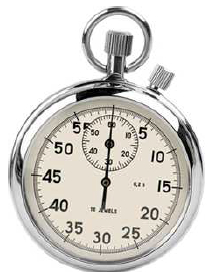
Mechanical stopwatch
ID:(2237, 0)

Time and celestial stars
Video
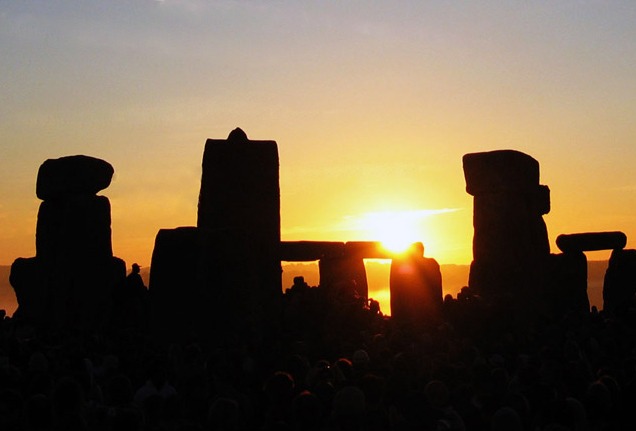
Celestial stars are used as a method to measure time by tracking the movements of stars, planets, and other celestial objects in the night sky. This is done using precise instruments, like telescopes and astrolabes, to identify the exact locations of celestial objects at specific points in time. This allows us to measure the passing of time, and to keep track of the changing positions of celestial objects in the sky over long periods of time. This method of time-keeping has been used for centuries, and can be used to accurately determine the time of day, or the time of year.
ID:(476, 0)

Time and sun
Unit
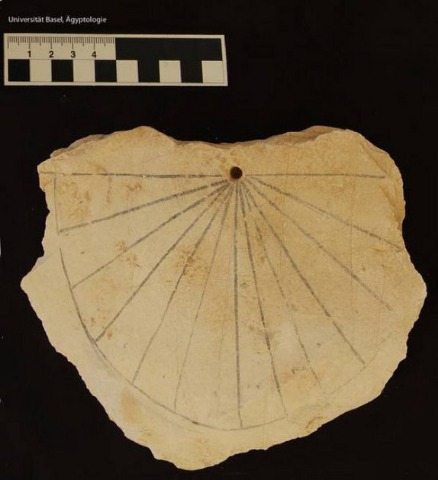
Sun time is a method of measuring time based on the position of the sun in the sky. The sun rises in the east and sets in the west each day, providing a way to measure the passing of time. It is the most widely used method of measuring time in many cultures and is based on the principle of a day being divided into 24 hours.
ID:(9484, 0)

Astrolab
Code
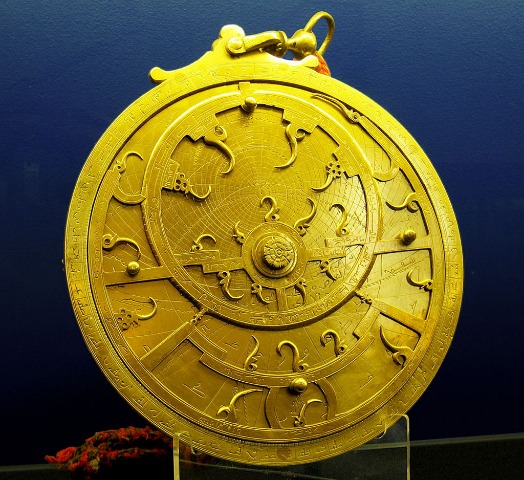
An astrolabe is an ancient astronomical instrument used to measure the positions of stars, planets, and other celestial bodies. It can also be used to measure the time of day, latitude, and other navigational information. The astrolabe consists of a graduated disk, known as the rete, which is mounted on a graduated circle, known as the alidade. The two parts are connected by an arm, known as the rule, and the user can move the rule to measure the positions of celestial bodies. The astrolabe was used throughout the Middle Ages and Renaissance, and it remains an important tool in navigation and astronomy today.
Sunrise at Stonehenge for the summer solstice (06.21.2005). (Modified from Wikimedia Commons, Summer Solstice Sunrise over Stonehenge 2005.jpg)
ID:(9487, 0)
Hourglass
Flux
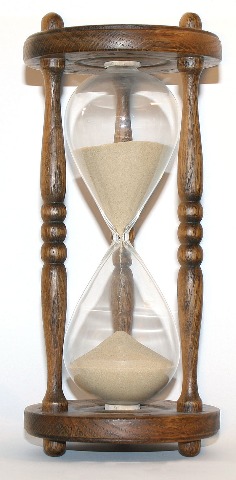
Hourglass is a device used to measure the passage of time. It consists of a glass vessel with a narrow neck that contains a quantity of sand or a similar material. The sand runs out of the top of the hourglass, through the neck, and into the bottom chamber of the vessel. As the sand runs out, it marks the passage of time, with the amount of time marked being determined by the amount of sand in the hourglass.
ID:(9494, 0)
Candle clock
Matrix
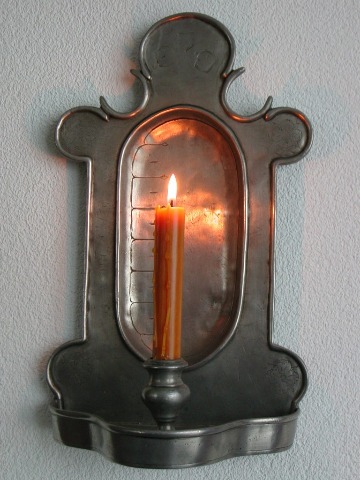
A candle clock is a device that uses the burning of a candle to measure the passage of time. It is believed to have been invented by the Chinese in the fourth century and was used in Europe in the Middle Ages. The candle clock works by having a candle with a certain length. The candle is lit and the time is measured by the length of time it takes for the candle to burn down to a specific mark. The candle can be marked at various intervals to give a more accurate measurement of time.
ID:(9486, 0)
Water clock
Html
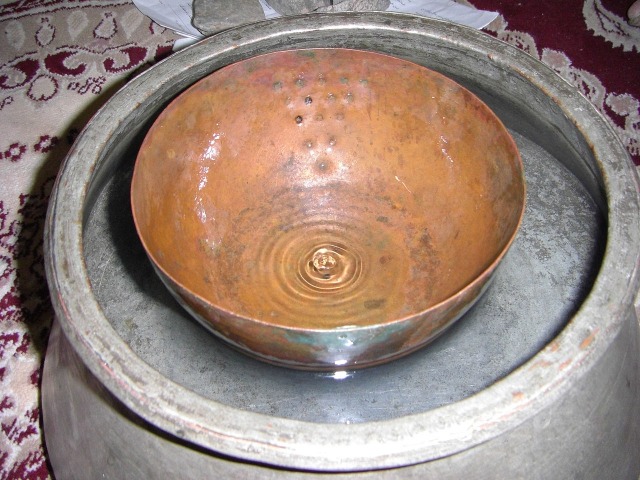
A water clock is a device used to measure time by tracking the passage of a certain amount of water over time. It works by having a container with a small hole in the bottom. The water in the container slowly drips out of the hole, and a mechanism is used to track how much water has passed. This mechanism is calibrated to indicate a certain amount of time has passed. Water clocks were used before mechanical clocks and are still used in some parts of the world today.
ID:(9493, 0)
Diagram of a water clock
Php
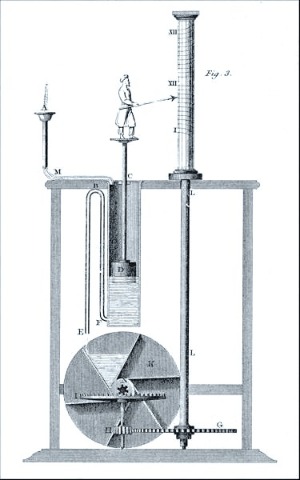
The water clock is an ancient mechanical device that uses the constant flow of water to keep time. The weight of the water is placed in an upper container, which falls through a glass tube to a lower container. The constant flow of water generates a pressure force, which causes the weight to turn a central axle, moving the disc which in turn rotates the hour reading cylinder. The water clock is usually used as a cheap way to keep time, as it does not require electrical power to operate. However, the water flow must be constant for the clock to remain on time. If the water flow is too low, the clock could stop.
ID:(9485, 0)

Pendulum clock
Iframe
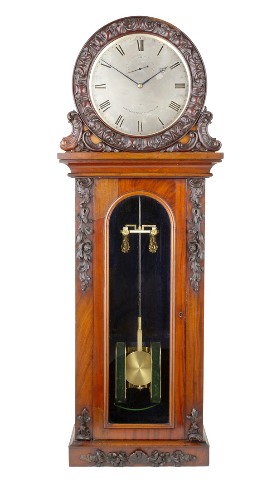
A pendulum clock is a clock that uses a pendulum, a swinging weight, to keep time. The pendulum swings back and forth, driven by gravity, and its motion is regulated by a precision-made escapement mechanism. The clock keeps accurate time by counting the swings of the pendulum as they occur. Pendulum clocks were invented in the 17th century and were the most accurate timekeeping devices until the invention of the quartz clock in the 1930s.
ID:(9489, 0)

Mechanical astronomical clock
Simulation
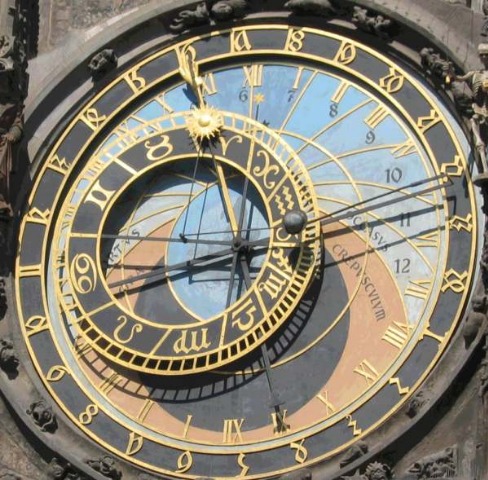
A mechanical astronomical clock is a timekeeping device that is powered by a mechanical movement, rather than by electricity or batteries. It is designed to track the position of the sun, moon, and stars in the sky, and to accurately measure the passage of time. The clock typically uses a combination of gears and pendulums to replicate the movements of the celestial bodies, and can be used to calculate the time of day, the date, and the position of the sun and moon in the sky.
ID:(9488, 0)
Pocket Watch
Table
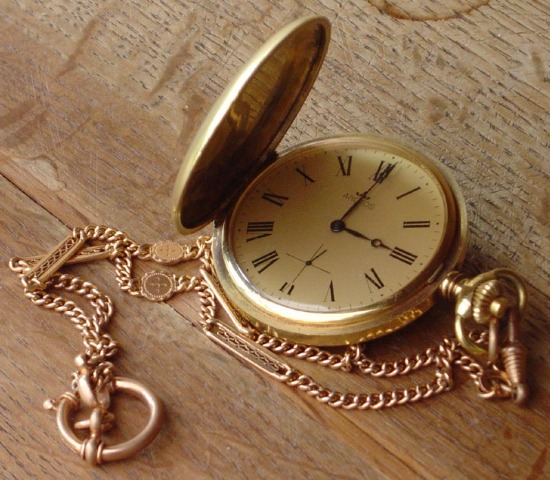
A pocket watch is a small, portable timepiece that is designed to be carried in a person's pocket. It is typically designed with a hinged metal case and a metal chain that is used to attach it to a belt or clothing. The watch typically has a face with hands that rotate to indicate the time and can also include features such as a stopwatch, alarm, and calendar. Pocket watches are powered by a mechanical movement, although some modern pocket watches use quartz movements.
ID:(9491, 0)
Mechanical wrist watch
Tabed
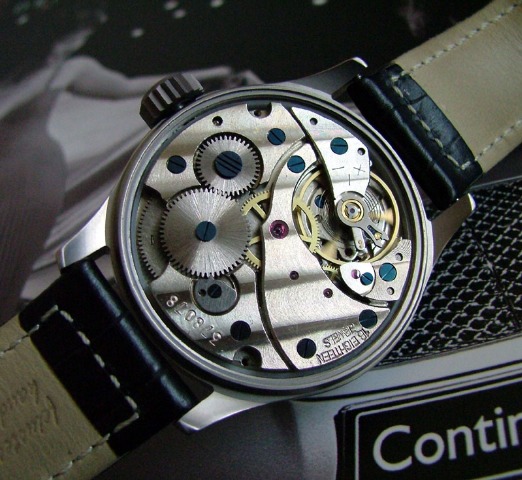
A mechanical wrist watch is a timekeeping device that uses a mechanical movement powered by a mainspring to measure and display the passing of time. The mainspring is wound either by turning a small knob on the side of the watch, or by manually winding it with a key. The mechanical movement of the watch powers a series of gears and cogs that turn the hands of the watch to measure the passing of time.
ID:(9492, 0)
Quartz watch
Calculation
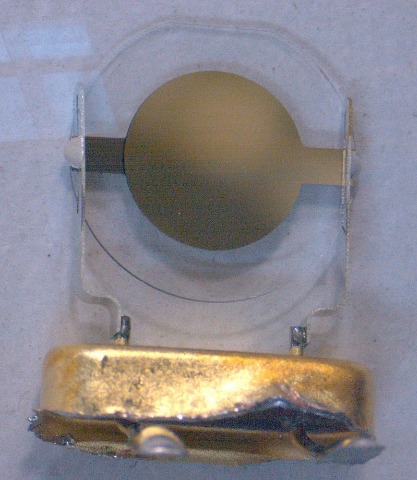
A quartz watch is a type of watch that uses a quartz crystal to keep time. This crystal vibrates at a frequency of 32,768 times per second, which is then used to power a digital or analog watch. The quartz crystal is connected to a battery and an integrated circuit, which measures and controls the frequency of the crystal, keeping it accurate to within a few seconds a month. Quartz watches are the most common type of watch used today and are known for their accuracy and durability.
ID:(9490, 0)

Time
Description
Time is a fundamental concept in physics and philosophy that represents the progression of events from the past through the present and into the future. It is often thought of as a continuous, irreversible flow, and it plays a crucial role in our perception of reality and the order of events. In physics, time is considered one of the four dimensions of spacetime, along with three dimensions of space. It is used as a coordinate to specify the position of events in the universe. Time can be measured and quantified using various units, such as seconds, minutes, hours, days, and so on.

Variables

Calculations
 to
to  ,
then, select the variable:
,
then, select the variable:  to
to 
Calculations
Variable
 Given
Calculate
Given
Calculate
 Target :
Equation
To be used
Target :
Equation
To be used

Equations

Examples
Time is defined based on its use in measurement and perception. The independence of its laws, the definition of references, and the various methods of measurement are highlighted.
Regarding measurements, a distinction is made between time itself and the initial time, reflecting the elapsed time, whether discrete or infinitesimal as needed.
(ID 15387)
There are two streams of thought regarding what time is:
• Time is part of the structure of the universe and independent of the events that occur within it. This is often referred to as the Newtonian view of time.
• Time is not part of the structure of the universe but rather a part of human perception that allows for the sequencing and comparison of events. This view is attributed to Gottfried Leibniz and Immanuel Kant.
From a physics standpoint, the latter view has become increasingly relevant.
(ID 475)
The basic unit of time within the International System of Units (International System of Units) is the second. A second corresponds to 9192631770 oscillation periods of the radiation emitted during the transition between two hyperfine levels of the ground state of the cesium atom Cs133. This radiation is known as 'cesium wave', and was defined by convention in 1967 by the International Committee on Weights and Measures (BIPM). The definition is based on an average of the oscillation periods of the cesium wave at a temperature of 0 degrees Celsius and a pressure of 101325 Pascals. A second is divided into 1000 milliseconds, and a millisecond into 1000 microseconds.
(ID 473)
Physics is understood as being time-invariant, meaning that processes will develop in the same way regardless of when they start. This means that laws do not change over time and are therefore time-invariant. This feature is essential for the study of the evolution of systems, as if it did not depend on the time it was initiated, we can speak of universal laws that apply to any situation or context.
(ID 9550)
The evolution of any system is described by different parameters, each one evolving according to a scale called the time ($t$).
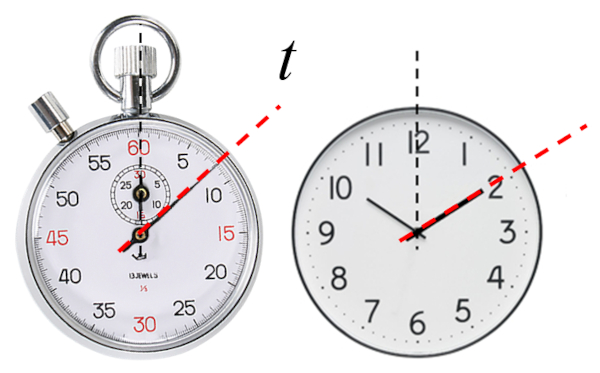
Time indicated by a clock, either the value at which it is marked or the hour
Traditionally, time was considered absolute in classical physics, being the same in all reference systems. However, the theory of relativity has generalized this concept and now it must be seen as unique to each reference system, being able to differ in its advancement.
(ID 478)
Systems are time-invariant, meaning that their behavior is not affected by when the process begins. This allows us to choose the start Time ($t_0$), based on what is most convenient. This could be based on the instrument used to measure the time or to make calculations easier.
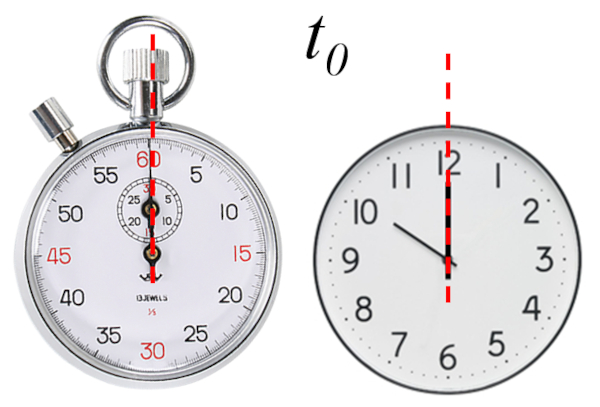
The time at which the measurement starts, whether fixed or by system (stopwatch)

Ultimately, the beginning time can be chosen freely.
(ID 715)
The foundation of describing any evolution is the definition of time in which it is described. Specifically, we work with the time elapsed ($\Delta t$) from a reference time.
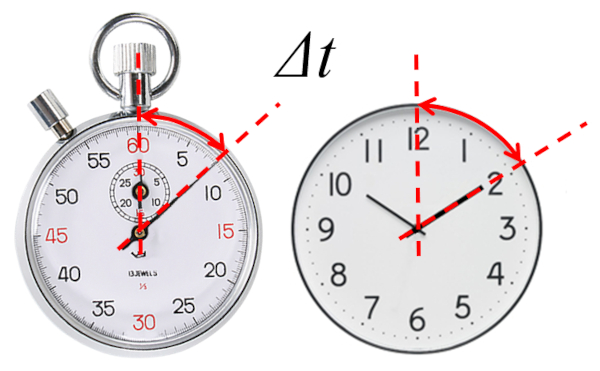
The stopwatch directly gives us the elapsed time since its initial time is zero
In the case of a stopwatch, the elapsed time is measured from the start of its measurement, i.e., a zero initial time ($t_0=0$).
In the case of the clock, it is necessary to define the initial type in order to determine the elapsed time.
In the case of a clock, the elapsed time is measured from a defined initial time, which may or may not be zero.
Since the time elapsed ($\Delta t$) is calculated as the difference between the time ($t$) and the start Time ($t_0$):
| $ \Delta t \equiv t - t_0 $ |
it is possible to "shift" the time origin by adding a constant value
to both time points:
$t \rightarrow t + \tau$
$t_0 \rightarrow t_0 + \tau$
without affecting the elapsed time:
$\Delta t = t - t_0 \rightarrow (t + \tau) - (t_0 + \tau) = t - t_0 = \Delta t$
This property is known as temporal invariance, meaning that the elapsed time remains unchanged regardless of the specific starting point of the measurement.
Consequently, laws formulated using this principle will be temporally invariant, meaning they remain valid whether applied in the present, the past, or the future.
(ID 12507)
If the elapsed time $\Delta t$ is very short, we speak of an infinitesimal time and the difference is denoted by a $d$ instead of $\Delta$, that is, $dt$.
$dt:\Delta t \rightarrow 0$
The usefulness of defining very short times is that variations in magnitudes over time can be studied around a specific time, rather than as average values over a longer time.
When a magnitude is defined as a ratio of a variable over time $\Delta t$ (such as velocity), its version defined with the infinitesimal time interval $dt$ is referred to as the instantaneous variation (instantaneous velocity).
(ID 9471)
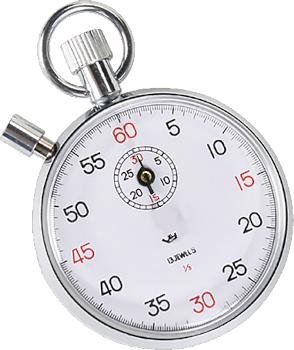
A stopwatch is a special clock that allows measuring the time elapsed between two events by being able to start and stop as needed. The start time is recorded upon starting the measurement, while the end time is measured upon stopping the stopwatch. Generally, its precision is one second and it can measure up to an hour of total time. However, the main source of imprecision is the action of starting and stopping the stopwatch, which can introduce an error of several tens of seconds.
Mechanical stopwatch
(ID 2237)
Celestial stars are used as a method to measure time by tracking the movements of stars, planets, and other celestial objects in the night sky. This is done using precise instruments, like telescopes and astrolabes, to identify the exact locations of celestial objects at specific points in time. This allows us to measure the passing of time, and to keep track of the changing positions of celestial objects in the sky over long periods of time. This method of time-keeping has been used for centuries, and can be used to accurately determine the time of day, or the time of year.
(ID 476)
Sun time is a method of measuring time based on the position of the sun in the sky. The sun rises in the east and sets in the west each day, providing a way to measure the passing of time. It is the most widely used method of measuring time in many cultures and is based on the principle of a day being divided into 24 hours.
(ID 9484)
An astrolabe is an ancient astronomical instrument used to measure the positions of stars, planets, and other celestial bodies. It can also be used to measure the time of day, latitude, and other navigational information. The astrolabe consists of a graduated disk, known as the rete, which is mounted on a graduated circle, known as the alidade. The two parts are connected by an arm, known as the rule, and the user can move the rule to measure the positions of celestial bodies. The astrolabe was used throughout the Middle Ages and Renaissance, and it remains an important tool in navigation and astronomy today.
Sunrise at Stonehenge for the summer solstice (06.21.2005). (Modified from Wikimedia Commons, Summer Solstice Sunrise over Stonehenge 2005.jpg)
(ID 9487)
Hourglass is a device used to measure the passage of time. It consists of a glass vessel with a narrow neck that contains a quantity of sand or a similar material. The sand runs out of the top of the hourglass, through the neck, and into the bottom chamber of the vessel. As the sand runs out, it marks the passage of time, with the amount of time marked being determined by the amount of sand in the hourglass.
(ID 9494)
A candle clock is a device that uses the burning of a candle to measure the passage of time. It is believed to have been invented by the Chinese in the fourth century and was used in Europe in the Middle Ages. The candle clock works by having a candle with a certain length. The candle is lit and the time is measured by the length of time it takes for the candle to burn down to a specific mark. The candle can be marked at various intervals to give a more accurate measurement of time.
(ID 9486)
A water clock is a device used to measure time by tracking the passage of a certain amount of water over time. It works by having a container with a small hole in the bottom. The water in the container slowly drips out of the hole, and a mechanism is used to track how much water has passed. This mechanism is calibrated to indicate a certain amount of time has passed. Water clocks were used before mechanical clocks and are still used in some parts of the world today.
(ID 9493)
The water clock is an ancient mechanical device that uses the constant flow of water to keep time. The weight of the water is placed in an upper container, which falls through a glass tube to a lower container. The constant flow of water generates a pressure force, which causes the weight to turn a central axle, moving the disc which in turn rotates the hour reading cylinder. The water clock is usually used as a cheap way to keep time, as it does not require electrical power to operate. However, the water flow must be constant for the clock to remain on time. If the water flow is too low, the clock could stop.
(ID 9485)
A pendulum clock is a clock that uses a pendulum, a swinging weight, to keep time. The pendulum swings back and forth, driven by gravity, and its motion is regulated by a precision-made escapement mechanism. The clock keeps accurate time by counting the swings of the pendulum as they occur. Pendulum clocks were invented in the 17th century and were the most accurate timekeeping devices until the invention of the quartz clock in the 1930s.
(ID 9489)
A mechanical astronomical clock is a timekeeping device that is powered by a mechanical movement, rather than by electricity or batteries. It is designed to track the position of the sun, moon, and stars in the sky, and to accurately measure the passage of time. The clock typically uses a combination of gears and pendulums to replicate the movements of the celestial bodies, and can be used to calculate the time of day, the date, and the position of the sun and moon in the sky.
(ID 9488)
A pocket watch is a small, portable timepiece that is designed to be carried in a person's pocket. It is typically designed with a hinged metal case and a metal chain that is used to attach it to a belt or clothing. The watch typically has a face with hands that rotate to indicate the time and can also include features such as a stopwatch, alarm, and calendar. Pocket watches are powered by a mechanical movement, although some modern pocket watches use quartz movements.
(ID 9491)
A mechanical wrist watch is a timekeeping device that uses a mechanical movement powered by a mainspring to measure and display the passing of time. The mainspring is wound either by turning a small knob on the side of the watch, or by manually winding it with a key. The mechanical movement of the watch powers a series of gears and cogs that turn the hands of the watch to measure the passing of time.
(ID 9492)
A quartz watch is a type of watch that uses a quartz crystal to keep time. This crystal vibrates at a frequency of 32,768 times per second, which is then used to power a digital or analog watch. The quartz crystal is connected to a battery and an integrated circuit, which measures and controls the frequency of the crystal, keeping it accurate to within a few seconds a month. Quartz watches are the most common type of watch used today and are known for their accuracy and durability.
(ID 9490)
(ID 15388)
ID:(606, 0)