
 User:
User:


CIDOS and Qualicon
Storyboard

Upon returning to Chile, I founded CIDOS (Santiago Research and Development Center), a company dedicated to the development of solutions and consulting for European organizations through the Swiss firm Qualicon.
The success of this collaboration led to Qualicon attempting to assume greater control over CIDOS operations. As a consequence, we decided to reorient our activity towards the Chilean market. Subsequently, through a strategic alliance with the company ProQualitas, we began to develop projects together with Price Waterhouse Chile, a relationship that finally culminated with my personal incorporation into this firm.
ID:('ky', 1782)
Solving a noise problem through physical flow analysis
Storyboard
The Swiss company Biral AG, a manufacturer of centrifugal pumps, requested technical support after detecting an unexpected problem in one of its new designs. In order to improve hydraulic performance, the geometry of the impeller had been modified by reducing the exit section of the blades. As a result, water left the impeller at a considerably higher velocity. However, once the first prototypes were built, the pumps began to emit an intense operating noise, described by the engineers themselves as a real "howl", making their commercialization unfeasible.
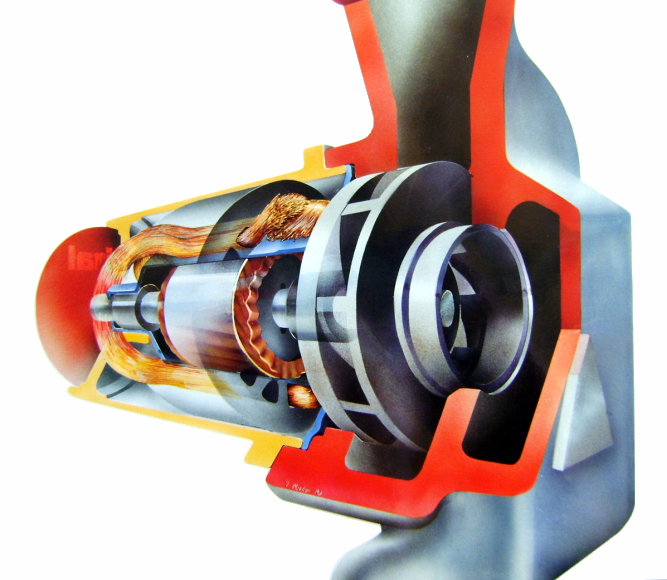
The study focused on understanding the physical origin of the phenomenon, analyzing the relationship between the new geometry of the impeller and the behavior of the water flow. The analysis showed that the increase in speed favored the formation of vortices and turbulent structures at the impeller outlet. These flow instabilities generated periodic pressure fluctuations that mechanically excited the pump, producing the characteristic noise level observed during its operation.
More importantly, the study allowed us to conclude that this behavior not only explained the acoustic problem. The high speeds and low pressures associated with the vortices suggested that, under certain operating conditions, cavitation phenomena could begin, capable of producing progressive erosion of the impeller and significantly reducing the useful life of the pump.
The proposed solution consisted of modifying the hydraulic geometry again, increasing the outlet section of the impeller to reduce the flow speed before leaving the impeller. This modification decreased the intensity of the vortices, stabilized the flow and reduced the pressure fluctuations responsible for noise. As a result, the sound level returned to acceptable values and, at the same time, the risk of cavitation and the damage it could cause during prolonged operation of the pump was reduced.
This project was a clear example of how analysis based on physical principles allows us to identify the real cause of an engineering problem and develop solutions that not only eliminate the visible symptomin this case noisebut also the mechanisms that could compromise the reliability and durability of the system in the future.
ID:('gp', 686)
Identifying the cause of intermittent water valve failure
Storyboard
The Swiss company KWC, internationally recognized for the manufacture of high-quality faucets, requested support to investigate a problem that affected one of its water faucet models. Although the product worked correctly when it left the factory, approximately 10% of customers reported that, after a few months of use, the mechanism began to jam until it prevented its normal operation, making it necessary to replace the entire key.
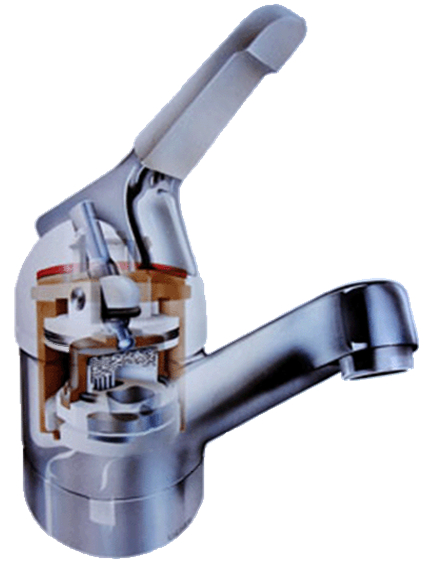
The main difficulty of the study was that the problem did not occur in all units, but only in a fraction of them and after a relatively long period of use. This characteristic made it very difficult to reproduce the failure through conventional laboratory tests, so it was necessary to analyze in detail the design of the mechanism, the operating conditions and the possible variations present during the manufacturing and daily use of the product.
The work focused on identifying what combination of factors could explain why an apparently correct design evolved, over time, towards a condition in which the mechanism progressively increased its friction until it blocked. To do this, the mechanical tolerances, the behavior of the materials, the contact forces between the moving parts and the hydraulic conditions to which the valve was subjected during thousands of opening and closing cycles were studied.
The objective was not only to find the immediate cause of the failure, but to understand the physical mechanism that allowed it to appear only in certain units and after a period of operation. This approach made it possible to direct the analysis towards the true causes of the problem and provide the company with a technical basis to redesign the product, increasing its reliability and significantly reducing the probability of failures in service.
ID:('gp', 687)
Discovering the physical origin of an intermittent failure
Storyboard
The analysis of the closing mechanism made it possible to verify that the faucets that had failed had a common characteristic: they had lost the lubricant film located between the two ceramic surfaces responsible for regulating the flow of water. Without this lubrication, the friction between both pieces increased progressively until the mechanism ended up getting stuck, making it necessary to replace the entire key. The fundamental question was why this lubricant loss occurred in only a fraction of the installed units.
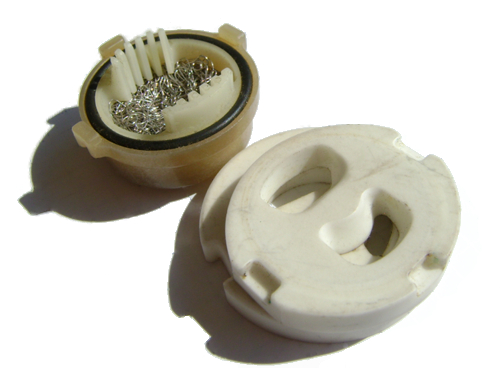
The study of the mechanism revealed that the component responsible for moving one of the ceramicsshown inverted in the figureapplied the force in a position that did not coincide with the sliding plane. Instead of generating only a force parallel to the ceramic surface, it also produced a small moment or torque that tended to rotate the upper ceramic during its movement. Although this rotation was very small, it was sufficient to gradually move the lubricant away from the contact surface.
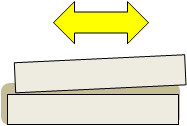
The analysis further showed that this phenomenon did not occur during normal use of the key. The torque only reached significant values when the applied force was high, a situation that occurred when closing the key abruptly, hitting the mechanism against its stop. This observation explained why the problem appeared only in a portion of the customers: wear did not depend on manufacturing differences, but rather on operating habits. Approximately ten percent of users closed the key with enough force to generate the necessary torque to progressively displace the lubricant and cause, over time, the mechanism to lock.
The solution consisted of modifying the geometry of the drive system by moving the support point of the mobile element. By reducing the distance between the line of action of the force and the fulcrum, the lever arm and, consequently, the torque applied to the ceramic was considerably reduced. With this, the movement became practically a pure sliding again, the displacement of the lubricant was avoided and the problem disappeared without the need to modify the materials or the basic design of the mechanism.
This project showed how a seemingly random phenomenon could be fully explained through a physical analysis of the system, allowing a simple and robust solution to be developed based on the mechanics of the mechanism, instead of resorting to material changes or unnecessary component replacements.
ID:('gp', 688)
Palos Verdes, Costa de Corral, Región de los Rios, Chile