
 User:
User:



Review of the Monte Carlo Method (MCM)
Storyboard 
Although the Monte Carlo method (MCM) is seen as the gold standard in the dose calculation, its application is limited by the computational effort. This is linked to the large number of particles that must be simulated in order to reduce the numerical uncertainty inherent in the complexity of the system. In this review the method is described and the problem of numerical uncertainty is reviewed.
ID:(1161, 0)

Random Walk
Definition
To explore the properties of Monte Carlo suppose that we want to simulate the behavior of a drunked.
He moves unidimensionally and can take steps to the right and to the left.
The distances traveled in each direction depend on the objects along the way. These are distributed randomly.
Each time he reaches an object, he reverses the direction in which he moves.
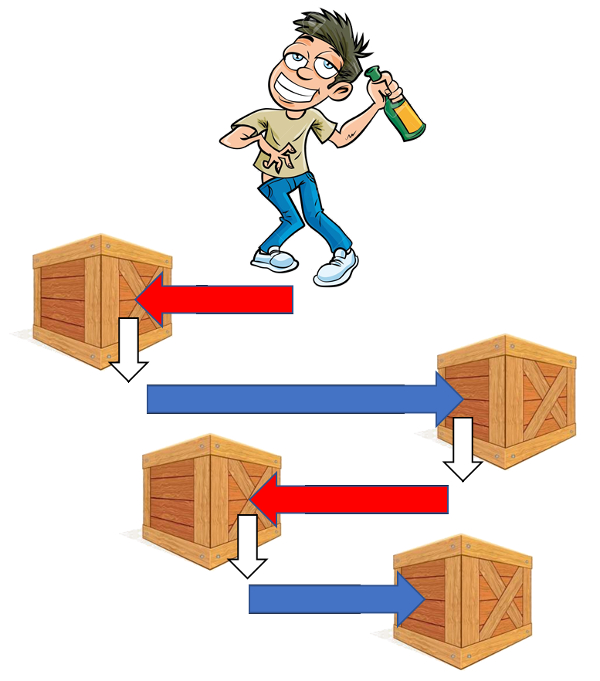
ID:(9175, 0)

Simulador random walk variable pitch
Image
In order to obtain the distribution of the particulars according to the position, it is possible to perform an iteration in which
```
0. A starting position and direction is defined
1. It is displaced by a distance generated randomly as a function of the distance probability in a direction
2. the direction is reversed
3. continued in 1
```
If we assume that we expect a definite time and that the particle moves at constant speed, we can determine the position it has after a given time or after a definite total path.
ID:(9100, 0)

Summary
Note
Playing with the simulator we noticed that
```
1. It only makes sense to consider distributions of possible positions
2. The distribution is based on determining positions in discrete ranges
3. Ranges of smaller size require a greater number of iterations
```
ID:(9101, 0)

Compton Scattering
Quote
Compton scattering occurs when a photon interacts with a charged particle, in particular with an electron. In the process the photon loses energy and deviates by putting the electron in motion:

ID:(9176, 0)

Simulador random walk with Compton scattering
Exercise
The Klein-Nishina model can be studied in numerical form. This is shown
- the total effective section as a function of photon energy
- the differential section as a function of the angle for the minimum, medium and maximum energies defined
- what would be the total effective section in a one-dimensional system that gives according to the energy transmission or reflection
ID:(9114, 0)
Review of the Monte Carlo Method (MCM)
Storyboard
Although the Monte Carlo method (MCM) is seen as the gold standard in the dose calculation, its application is limited by the computational effort. This is linked to the large number of particles that must be simulated in order to reduce the numerical uncertainty inherent in the complexity of the system. In this review the method is described and the problem of numerical uncertainty is reviewed.
Variables

Calculations
 to
to  ,
then, select the variable:
,
then, select the variable:  to
to 
Calculations
Variable
 Given
Calculate
Given
Calculate
 Target :
Equation
To be used
Target :
Equation
To be used

Equations

Examples
To explore the properties of Monte Carlo suppose that we want to simulate the behavior of a drunked.
He moves unidimensionally and can take steps to the right and to the left.
The distances traveled in each direction depend on the objects along the way. These are distributed randomly.
Each time he reaches an object, he reverses the direction in which he moves.
The simplest case is that of a particular movimg along an axis that can impact some object, after which it will reverse its direction of advance.
If the probability of reaching a distance between
If this probability is proproposal to the probability itself
and get the probability function
We will call
In order to obtain the distribution of the particulars according to the position, it is possible to perform an iteration in which
```
0. A starting position and direction is defined
1. It is displaced by a distance generated randomly as a function of the distance probability in a direction
2. the direction is reversed
3. continued in 1
```
If we assume that we expect a definite time and that the particle moves at constant speed, we can determine the position it has after a given time or after a definite total path.
Playing with the simulator we noticed that
```
1. It only makes sense to consider distributions of possible positions
2. The distribution is based on determining positions in discrete ranges
3. Ranges of smaller size require a greater number of iterations
```
The total effective section
with which it is possible to estimate the probability of impact with the total effective section:
Compton scattering occurs when a photon interacts with a charged particle, in particular with an electron. In the process the photon loses energy and deviates by putting the electron in motion:
Compton scattering occurs when a photon interacts with an electron by transferring the first energy to the second (inelastic interaction). The wavelength of the photon after the scattering can be calculated by
where
Compton wave length and
In the case of Compton scattering, the differential effective section is according to Klein-Nishina
where
is the Thomson total effective section and the
is the normalized energy.
If the differential effective section is taken according to Klein-Nishina
and integrates in the solid angle
the total effective section is obtained
where
is the effective section of Thomson and the
is the normalized energy.
At the limit of small
and in the limit
The Klein-Nishina model can be studied in numerical form. This is shown
- the total effective section as a function of photon energy
- the differential section as a function of the angle for the minimum, medium and maximum energies defined
- what would be the total effective section in a one-dimensional system that gives according to the energy transmission or reflection
ID:(1161, 0)