
 User:
User:



Concept: Hydraulic transport
Storyboard

It models the flow of water through the soil-plant-atmosphere continuum (SPAC). Water rises through the xylem driven by gradients of water potential (), from less negative values in the soil to the most negative ones in the leaf. The cohesion-tension mechanism maintains the water column in metastability. Phloem transports solutes in source-sink solution. The model determines the total hydraulic conductance, cavitation under extreme stress and stomatal regulation as an integrative response.
ID:('ky', 1)

Model: Hydraulic transport
Storyboard
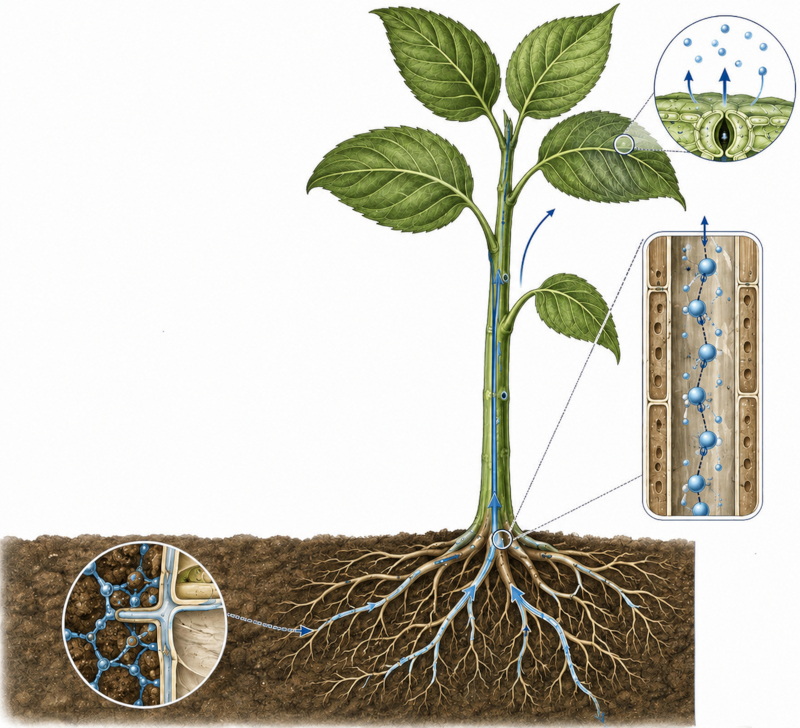
The image summarizes the integrated functioning of the soil-plant-atmosphere (SPAC) system, showing how water is captured by the roots, transported through the xylem and finally released to the atmosphere through transpiration. Instead of representing isolated processes, the model shows a continuous transport chain in which each stage depends directly on the others.
The process begins in the soil, where water is retained between mineral particles and organic matter. The lower left enlargement illustrates that water does not constitute a free reservoir, but rather occupies a complex network of pores and capillary films from which it must be extracted by the roots. As water is absorbed, it is incorporated into the plant's vascular system and begins its rise to the aerial parts.
Once inside the xylem, water forms a continuous column that moves through the conducting vessels of the stem. The lateral magnification shows that this transport occurs through a network of interconnected microscopic conduits, capable of transmitting the movement of water from the roots to the leaves. The flow is continuous and runs through the entire plant as a single hydraulic system.
In the leaves, water reaches the photosynthetic tissues, where a part is used in metabolic processes, while the largest fraction evaporates into the intercellular spaces. The upper right enlargement represents the last step of the journey: the water vapor leaves the leaf through the stomata and enters the atmosphere. This loss of water maintains the hydraulic gradient that drives transport from the roots, closing the functional cycle of the system.
The model highlights that the plant does not transport water through localized mechanical pumping. Instead, the entire system functions as a single hydraulic column in which water loss in the leaves generates the demand that maintains continuous movement from the ground. Root absorption, transport through the xylem and transpiration thus form a coupled process, where a modification in any of its components immediately affects the behavior of the whole.
This representation allows us to understand that water transport constitutes one of the fundamental processes of plant physiology. In addition to supplying the cells, it maintains the turgor of the tissues, allows the transport of mineral nutrients from the soil, participates in thermal regulation through evaporation and provides the water necessary for photosynthesis. Consequently, the hydraulic functioning of the soil-plant-atmosphere system simultaneously conditions the growth, productivity and capacity of adaptation of the plant to changes in water availability and environmental conditions.
ID:('gp', 519)
Origin of water: the soil as a reservoir
Storyboard
Water transport in plants begins long before water enters the roots. Its origin is found in the soil, which acts as the hydraulic reservoir of the soil-plant-atmosphere system. However, the water stored in the soil is not completely free to be absorbed, since its availability depends on the energy state in which it is retained. The image illustrates the main physical mechanisms that determine this energy state and that constitute the starting point of hydraulic transport in the plant.
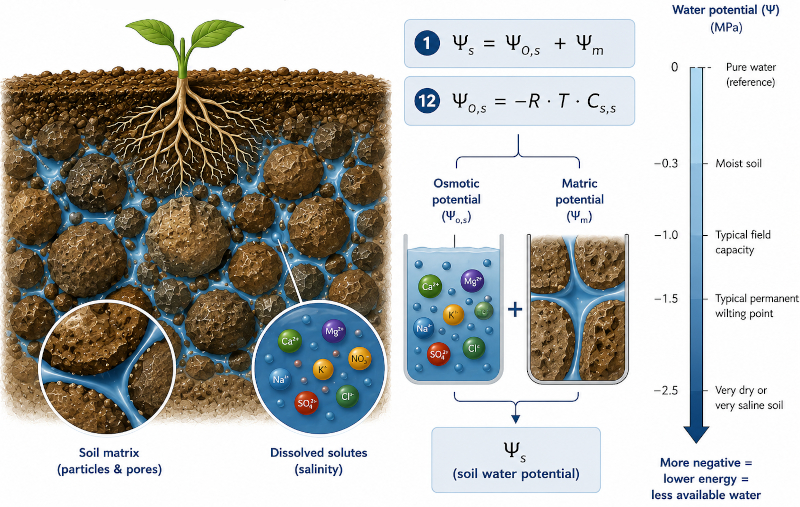
The cross section of the soil shows that water occupies a complex network of pores made up of mineral particles and organic matter. Part of the water fills relatively large spaces and can move easily, while another fraction remains attached to the surface of the particles through capillary and adsorption forces. This physical interaction between water and the soil matrix causes the matrix potential ($\Psi_m$), which represents the energy necessary to separate water from solid surfaces. The drier the soil is, the more intense this retention is and the more negative this potential becomes, decreasing the availability of water for the roots.
The magnification showing the dissolved ions represents the second mechanism that determines the energy of the water: the osmotic potential of the soil ($\Psi_{o,s}$). The presence of salts and other solutes reduces the free energy of water because part of the molecules remain associated with the dissolved ions. Consequently, by increasing the concentration of solutes ($C_{s,s}$), the osmotic potential decreases, making water less accessible to the plant. This behavior is described by equation (12), which relates the osmotic potential to the concentration of solutes, the temperature ($T$) and the universal gas constant ($R$).
The water potential of the soil ($\Psi_s$) results from the combination of these two physical mechanisms, as established in equation (1). In this model it is considered that the hydrostatic contribution of the soil is approximately zero and that the gravitational reference level corresponds to the soil surface, so the hydraulic state of the soil is determined only by the osmotic and matric components.
The vertical scale of water potential shown to the right summarizes the physical significance of these contributions. The zero value corresponds to pure water under reference conditions. As the water potential acquires more negative values, the available energy of the water decreases and the difficulty for it to be absorbed by the roots increases. A moist soil has potentials relatively close to zero, while a dry or highly saline soil has much more negative potentials due to the combined effect of physical retention and salinity.
From the model's point of view, the soil constitutes a boundary condition that the plant does not control. The initial energetic state of water is determined by the physical and chemical properties of the soil, establishing the energy level from which hydraulic transport to the roots, xylem and finally the leaves will begin. All subsequent functioning of the system ultimately depends on this initial availability of water imposed by the environment.
ID:('gp', 1)
Internal water status of the leaf
Storyboard
The transport of water through the plant does not depend only on the water available in the soil, but also on the energetic state that it reaches once it reaches the leaves. The leaf constitutes the upper end of the hydraulic system and is the place where the processes of transport, storage and loss of water to the atmosphere converge. The image summarizes the physical mechanisms that determine the water potential of the leaf and how it continually evolves in response to the balance between the water that enters from the xylem and that which is lost through transpiration.
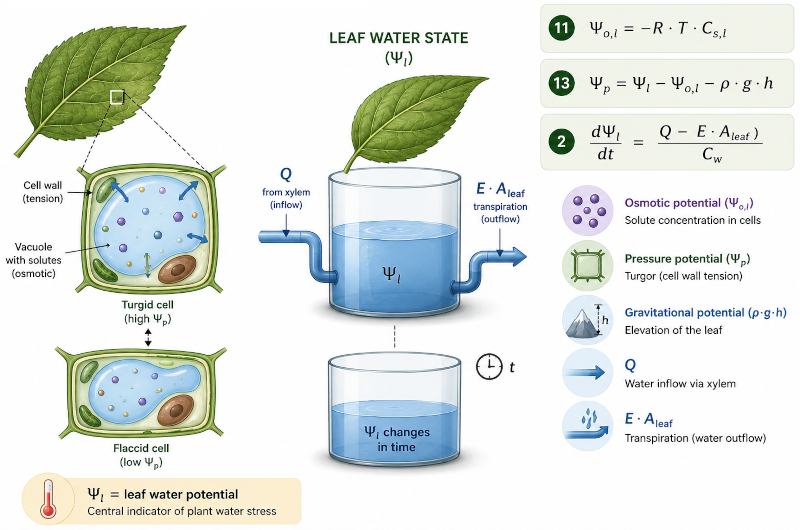
The plant cell represented on the left shows that the water stored in the leaf is simultaneously subjected to different energy contributions. The interior of the vacuole contains numerous solutes that decrease the free energy of water, causing the osmotic potential of the leaf ($\Psi_{o,l}$). This potential depends on the concentration of cellular solutes ($C_{s,l}$), as described in equation (11), so that an increase in the osmotic concentration reduces the water potential and promotes water retention within the cells.
At the same time, water exerts pressure on the cell wall, generating turgor pressure, represented by the pressure potential ($\Psi_p$). The comparison between the turgid cell and the flaccid cell illustrates how this potential reflects the mechanical state of the plant tissue. When cells contain abundant water, the cell wall remains under tension and the leaf retains its rigidity. On the other hand, as the water content decreases, the internal pressure decreases, the cells lose turgor and the tissue begins to wither. In this model, the pressure potential also incorporates the effect of the height that the water column must sustain within the plant, as considered in equation (13).
The central representation of the leaf as a water reservoir emphasizes that the leaf water potential ($\Psi_l$) does not remain constant, but varies continuously as a consequence of the hydraulic balance of the leaf. The flow of water from the xylem ($Q$) increases the water content of the tissue, while transpiration ($E$) causes a continuous loss of water to the atmosphere through the stomata. The water storage capacity of the fabric, represented by the hydraulic capacitance ($C_w$), cushions these variations, avoiding instantaneous changes in water potential. This temporal evolution of the water state is described by equation (2).
From the physical point of view, the leaf can be interpreted as a dynamic reservoir whose energy depends on the balance between water inputs and outputs and the osmotic and mechanical properties of its tissues. When water intake exceeds transpiration losses, water potential increases and cells regain their turgor. On the contrary, when evaporation exceeds the supply from the xylem, the water potential progressively decreases, increasing the hydraulic stress of the plant.
For this reason, the water potential of the leaf ($\Psi_l$) constitutes the main indicator of the water status of the plant. It summarizes the combined effect of hydraulic transport, osmotic regulation, cell turgor, leaf height and transpiration, becoming the central variable that determines the physiological response to conditions of limited water availability.
ID:('gp', 2)
Xylem transport and cavitation failure
Storyboard
Water transport from roots to leaves depends on the xylem's ability to maintain a continuous column of water under tension. This mechanism constitutes one of the most unique physical processes of vascular plants, since water rises without the help of a mechanical pump, driven solely by the difference in water potential between the soil and the leaves. The image shows how this transport can be progressively limited by the formation of cavitation, one of the main hydraulic failure mechanisms in plants.
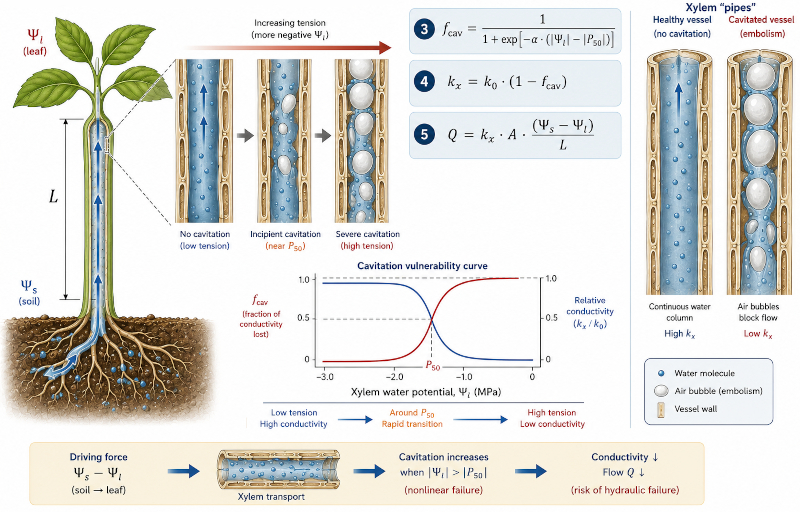
The left part of the image represents the flow of water through the xylem from the soil, characterized by the water potential $\Psi_s$, to the leaves, where the water potential $\Psi_l$ is more negative due to transpiration. This difference in energy constitutes the driving force that maintains the continuous rise of the water. The effective hydraulic path length ($L$) represents the distance the flow must travel, while the effective cross-sectional area ($A$) corresponds to the average capacity of the vascular system to transport water. These variables intervene in the calculation of the hydraulic flow described by equation (5).
The central sequence illustrates how the increase in hydraulic stress modifies the state of the xylem. When the water potential of the leaf progressively decreases and becomes more negative, the water column is subjected to increasing tension. As long as this tension remains within safe limits, the water maintains a continuous column and transport occurs normally. However, upon approaching a critical value characterized by the parameter $P50$, small air bubbles begin to form inside the conductive vessels. These bubbles, called embolisms, locally disrupt the continuity of the liquid column and reduce the xylem's ability to transmit water.
Embolism formation does not occur instantaneously, but rather increases progressively as the tension continues to grow. The fraction of affected vessels is represented by the variable $f_{cav}$, whose behavior is described by equation (3). The vulnerability curve shown in the figure shows that this process is highly nonlinear: during a wide interval the system remains relatively stable, but when approaching the threshold $P50$, small variations in the water potential produce a rapid increase in cavitation. This transition constitutes one of the characteristic features of plant hydraulics.
The comparison between a healthy vessel and a cavitated one shows the physical effect of this phenomenon. In an intact conduit, the continuous column of water transmits hydraulic stress throughout the entire vessel, allowing for efficient transport. On the other hand, when embolisms appear, part of the duct is occupied by air and stops contributing to the flow. As a consequence, the effective hydraulic conductivity ($k_x$) progressively decreases with respect to its initial value ($k_0$), as established by equation (4). As conductivity is reduced, the flow rate that the xylem can transport also decreases, even when the potential difference between soil and leaf continues to increase.
From a physical point of view, cavitation represents a degradation mechanism of the hydraulic system caused by excess tension in the water column. The plant obtains greater transport the more negative the water potential of the leaves becomes, but at the same time the risk of breaking the continuity of water within the xylem increases. This competition between hydraulic efficiency and structural safety constitutes one of the fundamental principles that regulate the functioning of the soil-plant-atmosphere system and determines the plant's ability to resist drought conditions or high evaporative demand.
ID:('gp', 3)
Stomatal control and perspiration
Storyboard
Gas exchange between the leaf and the atmosphere constitutes one of the main physiological regulation mechanisms of plants. Through the stomata, the plant must permanently resolve a compromise between two conflicting objectives: allowing the entry of carbon dioxide necessary for photosynthesis and, at the same time, limiting the loss of water through transpiration to avoid a deterioration in its hydraulic state. The image summarizes how this balance is regulated by stomatal opening and how this regulation directly determines the intensity of transpiration.
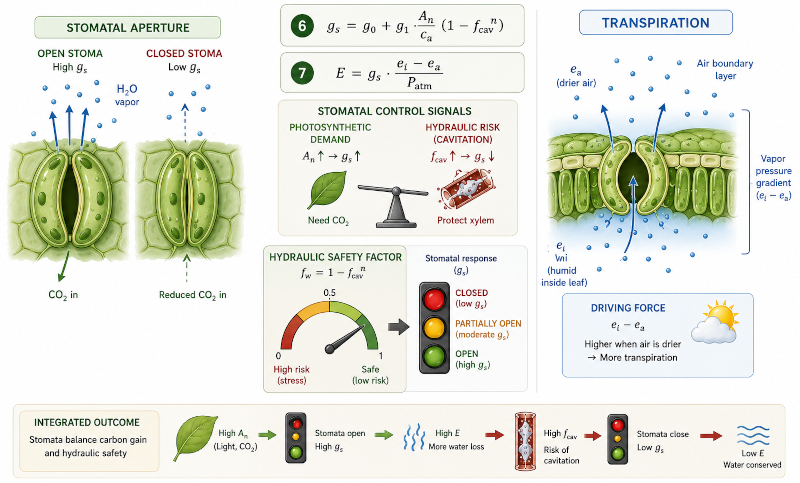
The left side of the image compares an open stoma with a partially closed one. The occlusive cells modify the size of the pore and, with this, regulate the stomatal conductance ($g_s$), which represents the ease with which gases cross the leaf surface. When the stoma opens, it simultaneously increases the input of carbon dioxide necessary for photosynthesis and the output of water vapor into the atmosphere. On the other hand, when the pore closes, both exchanges decrease. Stomatal conductance constitutes, therefore, the main control mechanism that the plant has over gas exchange with the environment.
The regulation of $g_s$ responds to the balance between two opposing physiological signals, represented in the center of the figure. On the one hand, high photosynthetic activity ($A_n$) favors stomatal opening to increase the supply of carbon dioxide. On the other hand, the increase in cavitation, represented by the fraction of affected vessels ($f_{cav}$), acts as a hydraulic risk signal that induces the progressive closure of the stomata to reduce water loss and protect the vascular system. This interaction is explicitly incorporated in equation (6), integrating both the photosynthetic demand and the hydraulic state of the xylem.
The hydraulic safety indicator shown in the figure summarizes this regulation strategy. When the risk of cavitation is low, the plant maintains a high stomatal opening and maximizes gas exchange. As water stress increases and the probability of cavitation increases, the opening progressively decreases until transpiration is restricted. This behavior constitutes a preventive mechanism that seeks to prevent the water potential of the leaves from continuing to decrease and causing an irreversible loss of conductivity in the xylem.
The right side of the image represents the physical process of perspiration. Water vapor diffuses from the interior of the leaf, where the vapor partial pressure ($e_i$) is high due to the evaporation of the water contained in the tissues, towards the atmosphere, where the partial pressure ($e_a$) is usually lower. The difference between the two constitutes the driving force of vapor diffusion. The drier the outside air is, the greater this difference and the more intense the water loss. The atmospheric pressure ($P_{atm}$) acts as a reference for the diffusion process, as considered in equation (7).
From the physical point of view, perspiration is an inevitable consequence of stomatal opening. Every time the plant opens its stomata to capture carbon dioxide, it also facilitates the escape of water vapor. Therefore, stomatal functioning represents a continuous balance between productivity and hydraulic safety. Excessive opening favors photosynthesis, but increases water loss and the risk of cavitation. Too intense a closure protects the hydraulic system, although it limits the availability of carbon dioxide and reduces photosynthetic capacity. This dynamic regulation constitutes one of the main mechanisms through which plants adapt to environmental variations and maintain the balance between growth and survival.
ID:('gp', 4)
Carbon fixation and CO2 availability
Storyboard
Carbon fixation constitutes the main physiological objective of gas exchange in the plant. Through the stomata, atmospheric carbon dioxide enters the leaf, diffuses through the intercellular spaces and finally reaches the chloroplasts, where light energy is used to synthesize organic compounds. The image summarizes how the availability of CO2 within the leaf results from the dynamic balance between the carbon that enters by diffusion and that which is continuously consumed during photosynthesis.
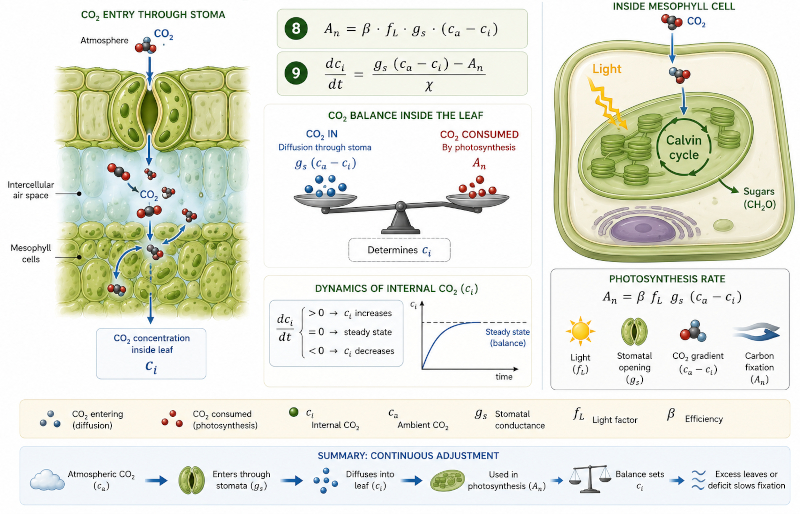
The left part of the image shows the path of carbon dioxide from the atmosphere to the interior of the mesophyll. The gas passes through the stoma driven by the concentration difference between the outside air, characterized by the atmospheric concentration of CO2 ($c_a$), and the interior of the leaf, where the concentration ($c_i$) is normally lower due to photosynthetic consumption. Stomatal aperture, represented by the conductance ($g_s$), controls the ease with which CO2 can diffuse into the internal tissues. The larger the opening of the stomata, the faster the carbon dioxide available for photosynthesis can be renewed.
Once CO2 reaches the mesophyll cells, it diffuses to the chloroplasts, where light energy, represented by the lighting factor ($f_L$), drives photosynthetic reactions. In this process, atmospheric carbon is incorporated into organic molecules through the Calvin cycle, giving rise to sugars and other compounds necessary for plant growth. The speed of this process is represented by the net photosynthesis rate ($A_n$), whose dependence on light, stomatal aperture, photosynthetic efficiency ($\beta$) and CO2 availability is incorporated into equation (8).
The central balance represents one of the most important physical aspects of the system: the internal concentration of carbon dioxide ($c_i$) does not remain constant, but results from the balance between two opposing processes. On the one hand, CO2 continuously enters from the atmosphere through diffusion; On the other hand, that same CO2 is consumed by photosynthetic reactions. When both processes compensate, the internal concentration remains stable. If income exceeds consumption, $c_i$ increases; If photosynthesis consumes more carbon than it manages to input, $c_i$ decreases. This dynamic evolution of internal CO2 is described by equation (9), where the parameter $\chi$ represents the ability of the system to buffer concentration changes over time.
The temporal graph shown in the image illustrates precisely this dynamic characteristic. Faced with a change in stomatal opening, lighting or atmospheric CO2 concentration, the internal concentration does not change instantly, but rather gradually evolves towards a new equilibrium. This transient response reflects the continuous interaction between carbon diffusion and its metabolic consumption within the leaf.
From the physical point of view, the process constitutes a dynamic system of input and consumption of matter. Diffusion continuously supplies carbon dioxide to the interior of the leaf, while photosynthesis acts as a sink that consumes it to produce biomass. The internal concentration of CO2 emerges as the variable that connects both processes, simultaneously regulating photosynthetic efficiency and gas exchange. In this way, the plant permanently adjusts the balance between the carbon available for growth and the ability to incorporate it using the energy provided by light.
ID:('gp', 5)
Integrated physiological performance
Storyboard
The physiological performance of a plant does not depend on a single process, but on the coordinated functioning of the entire hydraulic and photosynthetic system. From the absorption of water in the soil to the fixation of carbon in the leaves, each stage contributes to the final result: the amount of biomass that the plant is capable of producing for each unit of water it loses to the atmosphere. The image summarizes this integrated behavior through a single efficiency indicator that summarizes the balance between productivity and water consumption.
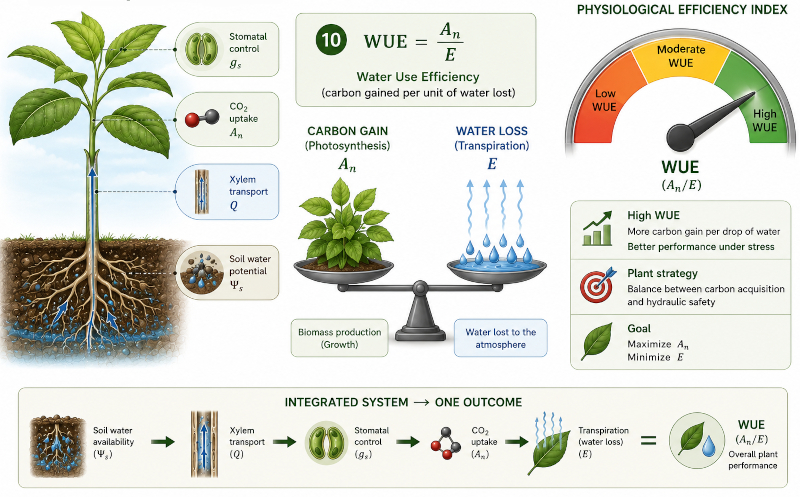
The left part of the image reminds that the operation of the plant begins with the availability of water in the soil, characterized by the water potential of the soil ($\Psi_s$). This water is transported by the xylem through hydraulic flow ($Q$) to the leaves, where the opening of the stomata, represented by the stomatal conductance ($g_s$), simultaneously regulates the entry of carbon dioxide and the exit of water vapor. As a consequence of this exchange, photosynthesis produces a carbon gain represented by the photosynthetic rate ($A_n$), while transpiration causes a continuous loss of water characterized by the evaporation rate ($E$).
In the center of the figure, the scale symbolizes the physical commitment between these two processes. The carbon fixed through photosynthesis constitutes the physiological benefit that allows growth and biomass production, while transpiration represents the hydraulic cost necessary to keep the stomata open and allow the entry of carbon dioxide. None of these processes can be maximized independently: increasing stomatal aperture favors photosynthesis, but also increases water loss; Excessively reducing perspiration conserves water, although it limits the availability of carbon for metabolism.
Water use efficiency ($WUE$) quantitatively summarizes this balance and constitutes the indicator defined in equation (10). Its value expresses how much carbon the plant manages to incorporate for each unit of water lost during transpiration. High values of WUE indicate that the plant maintains high productivity with relatively low water consumption, while low values reflect less efficient use of the water resource, either due to excessive water losses or limited photosynthetic capacity.
The indicator shown as a speedometer represents precisely this concept of integrated efficiency. It does not measure an isolated process, but rather the accumulated result of all the mechanisms previously described: water availability in the soil, hydraulic transport through the xylem, stomatal regulation, carbon dioxide diffusion and photosynthesis. Any modification in any of these processes ultimately impacts the value of $WUE$, making it an excellent summary of the overall physiological performance of the plant.
From the physical point of view, water use efficiency represents a measure of the energy use of the system. The plant transforms light energy into biomass, simultaneously using water as a means of transport and as a physiological resource. The objective is not to maximize only photosynthesis nor to minimize only transpiration, but to achieve the best possible balance between both processes. Therefore, WUE constitutes the final result of the model and synthesizes the physiological strategy adopted by the plant to maintain growth under different environmental conditions and water availability.
ID:('gp', 522)


Palos Verdes, Costa de Corral, Región de los Rios, Chile