
 User:
User:



Electric field rotor
Storyboard 
The electric field rotor seeks to detect if there is circulation in it. Circulation would mean that closed field lines existed, that without existing charges in space they close on themselves. A particle in that field would make a closed path without escaping or falling on or to any load. For the static case it is shown that there is no such circulation and that all field lines start and end in loads.
ID:(1569, 0)

Circulation
Definition
Cuando se estableció el potencial eléctrico se trabajo con la idea de caminos entre dos puntos que en el caso de ser serrados eran nulos:
| $ \Delta\varphi = -\displaystyle\int_C \vec{E}\cdot d\vec{s} $ |
Dichos caminos se pueden segmentar en caminos mas pequeños:
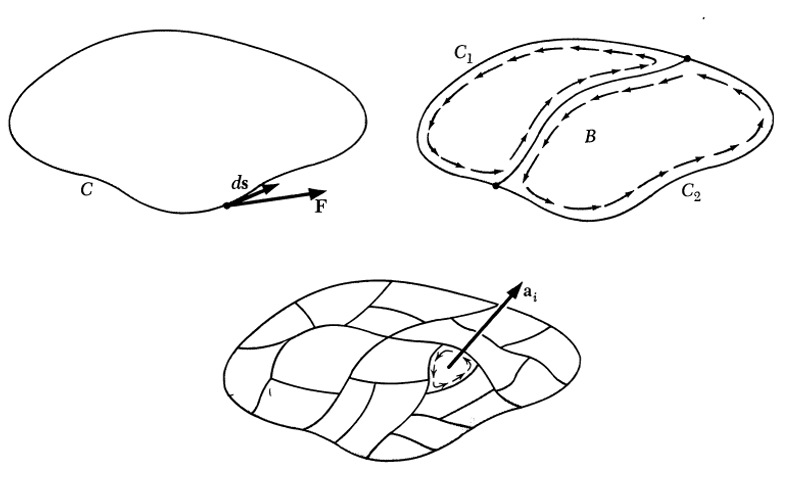
ID:(11569, 0)

Electric field rotor
Description
The electric field rotor seeks to detect if there is circulation in it. Circulation would mean that closed field lines existed, that without existing charges in space they close on themselves. A particle in that field would make a closed path without escaping or falling on or to any load. For the static case it is shown that there is no such circulation and that all field lines start and end in loads.
Variables

Calculations
 to
to  ,
then, select the variable:
,
then, select the variable:  to
to 
Calculations
Variable
 Given
Calculate
Given
Calculate
 Target :
Equation
To be used
Target :
Equation
To be used

Equations
None
(ID 11574)

Examples
Cuando se estableci el potencial el ctrico se trabajo con la idea de caminos entre dos puntos que en el caso de ser serrados eran nulos:
| $ \Delta\varphi = -\displaystyle\int_C \vec{E}\cdot d\vec{s} $ |
Dichos caminos se pueden segmentar en caminos mas peque os:
(ID 11569)
En base al integral a lo largo de un camino se puede definir la circulaci n como
| $ \Gamma = \displaystyle\int_C \vec{E}\cdot d\vec{s}$ |
(ID 11570)
Una circulaci n general
| $ \Gamma = \displaystyle\int_C \vec{E}\cdot d\vec{s}$ |
puede ser descompuesta en circulaciones menores
| $\displaystyle\int_C \vec{E}\cdot d\vec{s} = \displaystyle\sum_i \displaystyle\int_{C_i} \vec{E}\cdot d\vec{s}_i$ |
(ID 11571)
An logo a la definici n de la divergencia
| $\nabla\cdot\vec{E} = \lim_{V_i\rightarrow 0} \displaystyle\frac{1}{V_i}\displaystyle\int_{S_i} \vec{E}\cdot d\vec{S}_i$ |
se puede definir como el rotor la circulaci n por rea en la direcci n de la normal a la superficie
| $ (\nabla\times\vec{E})\cdot\hat{n} = \lim_{S_i\rightarrow 0}\displaystyle\frac{1}{ S_i }\displaystyle\int_{C_i}\vec{E}\cdot d\vec{s}$ |
(ID 11572)
Con la definici n del rotor
| $ (\nabla\times\vec{E})\cdot\hat{n} = \lim_{S_i\rightarrow 0}\displaystyle\frac{1}{ S_i }\displaystyle\int_{C_i}\vec{E}\cdot d\vec{s}$ |
se tiene que la suma sobre las superficies es
abla\times\vec{E})\cdot d\vec{S}=\displaystyle\int_S (
abla\times\vec{E})\cdot d\vec{S}
que corresponde al teorema de Stokes
| $ \displaystyle\int_C \vec{E} \cdot d\vec{s} =\displaystyle\int_S (\nabla\times\vec{E} )\cdot d\vec{S} $ |
(ID 11573)
As the circulation on a closed road is null
| $ \displaystyle\oint_C \vec{E}\cdot d\vec{s}=0$ |
Stokes' theorem
| $ \displaystyle\int_C \vec{E} \cdot d\vec{s} =\displaystyle\int_S (\nabla\times\vec{E} )\cdot d\vec{S} $ |
implies that
| $ \nabla\times\vec{E} = 0 $ |

This means that in the case of electrostatics the electric field has no circulation, that is, its lines do not form closed circles without touching charges.
(ID 11574)
ID:(1569, 0)