
 User:
User:



Application to Dose Calculations
Storyboard 
Since the Boltzmann equation includes collisions between particles, it is possible to estimate the energy delivered to the tissue and thus the dose in radiotherapy. Greater efficiency is achieved by working with particle distributions (photons, electrons and positrons) rather than individual particles as in the case of Monte Carlo. The introduction of cells using the Lattice Boltzmann Method (LBM) should also allow the possibility of choosing the precision according to the computational resources that are made available. This means that the algorithm should be able to pass continuously from a system equivalent to Pencil Beam, Convolution to Monte Carlo.
ID:(1164, 0)

Scattering
Definition
Scattering that contributes (in) or describes the abandonment of particles (out) can be plotted as follows:
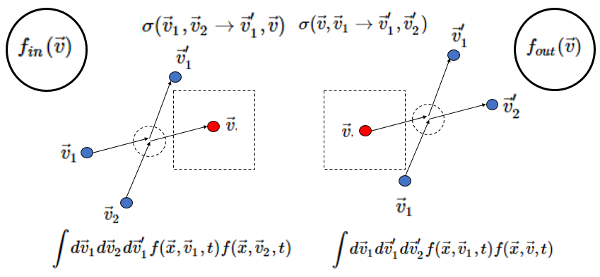
It should be noted that the term collision:
- integrates on all external speeds to those of volume
- includes the likelihood of both speeds leading to scattering simultaneously
- the relative velocity multiplied by the total effective section represents the flow of particles towards the target
The latter can be shown in a simple way through
ID:(9177, 0)
Application to Dose Calculations
Storyboard
Since the Boltzmann equation includes collisions between particles, it is possible to estimate the energy delivered to the tissue and thus the dose in radiotherapy. Greater efficiency is achieved by working with particle distributions (photons, electrons and positrons) rather than individual particles as in the case of Monte Carlo. The introduction of cells using the Lattice Boltzmann Method (LBM) should also allow the possibility of choosing the precision according to the computational resources that are made available. This means that the algorithm should be able to pass continuously from a system equivalent to Pencil Beam, Convolution to Monte Carlo.
Variables

Calculations
 to
to  ,
then, select the variable:
,
then, select the variable:  to
to 
Calculations
Variable
 Given
Calculate
Given
Calculate
 Target :
Equation
To be used
Target :
Equation
To be used

Equations

Examples
For the case in which they are considered uniformly distributed thermal photons their number per cell will be according to the distribution of Bose-Einstein
where
If the flow is isotropic it will be necessary that the $ m components will be equal and therefore:
In the case of the electrons it is necessary that the distribution in equilibrium is the one of Fermi-Direc so in the situation of equilibrium the distribution will have to be of the form
Otherwise the possible scatterings correspond to
- Absorption
- Elastic collision
- Electron-electron collision
- Excitation and deexicitation
Scattering that contributes (in) or describes the abandonment of particles (out) can be plotted as follows:
It should be noted that the term collision:
- integrates on all external speeds to those of volume
- includes the likelihood of both speeds leading to scattering simultaneously
- the relative velocity multiplied by the total effective section represents the flow of particles towards the target
The latter can be shown in a simple way through
In case the particles collide, the distribution function
$\displaystyle\frac{df}{dt}\neq 0$
Collisions cause particles of neighboring cells to undergo a collision that takes them to the cell under consideration and particles within the cell being expelled. The first leads to an increase of
In the case that they leave the cell it is considered
Integrating on one of the speeds that initiate the collision and both resulting since the other is the contribution to the local distribution function
In the case of contributions to the cell, consider
Integrating on the speeds that initiate the collision and one of the resulting ones since the other is the contribution to the local distribution function
ID:(1164, 0)