 User:
User:



Ocean movement, circulation
Storyboard 
Marine currents are generated by winds and changes in water density. The Coriolis force affects these vortices by deforming and influencing the depth they reach.
ID:(1560, 0)
Ocean movement, circulation
Storyboard
Marine currents are generated by winds and changes in water density. The Coriolis force affects these vortices by deforming and influencing the depth they reach.

Variables

Calculations
 to
to  ,
then, select the variable:
,
then, select the variable:  to
to 
Calculations
Variable
 Given
Calculate
Given
Calculate
 Target :
Equation
To be used
Target :
Equation
To be used

Equations
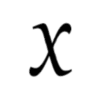
As the coriolis acceleration in x direction ($a_{c,x}$) is composed of the angular velocity of the planet ($\omega$), the latitude ($\varphi$), the speed y of the object ($v_y$), and the speed z of the object ($v_z$):
and the definition of the coriolis factor ($f$) is:
in addition to the constraint of movement on the surface where:
$v_z = 0$
this leads to the coriolis acceleration in x direction ($a_{c,x}$) being:
Since the coriolis acceleration in y direction ($a_{c,y}$) is composed of the angular velocity of the planet ($\omega$), the speed x of the object ($v_x$), and the latitude ($\varphi$):
and the definition of the coriolis factor ($f$) is:
in addition to the constraint of movement on the surface where:
$v_z = 0$
this leads to the coriolis acceleration in y direction ($a_{c,y}$) being:
Since the coriolis acceleration in y direction ($a_{c,y}$) is composed of the angular velocity of the planet ($\omega$), the speed x of the object ($v_x$), and the latitude ($\varphi$):
and the definition of the second Coriolis factor ($e$) is:
in addition to the constraint of movement on the surface where:
$v_z = 0$
this leads to the coriolis acceleration on the surface, in the z direction ($a_{c,z}$) being:

Examples
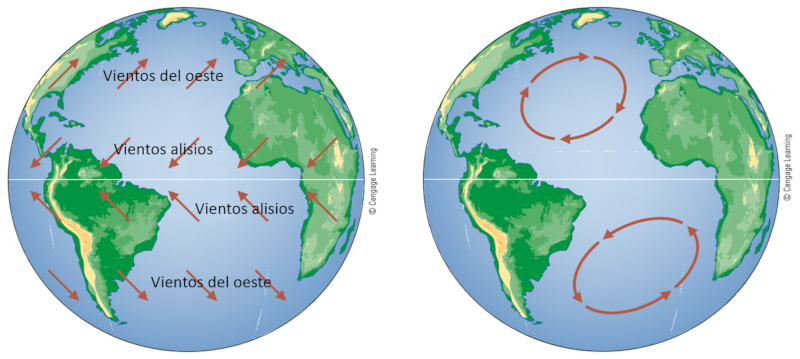
Las corrientes marinas son ageneradas por los vientos de superficie y fluctuaciones de la densidad del agua. El sentido de la circulaci n es definido por los vientos del oeste (westerlies) y vientos alisios (trade winds), generando circulaciones negativas en el hemisferio norte y positivas en el hemisferio sur.
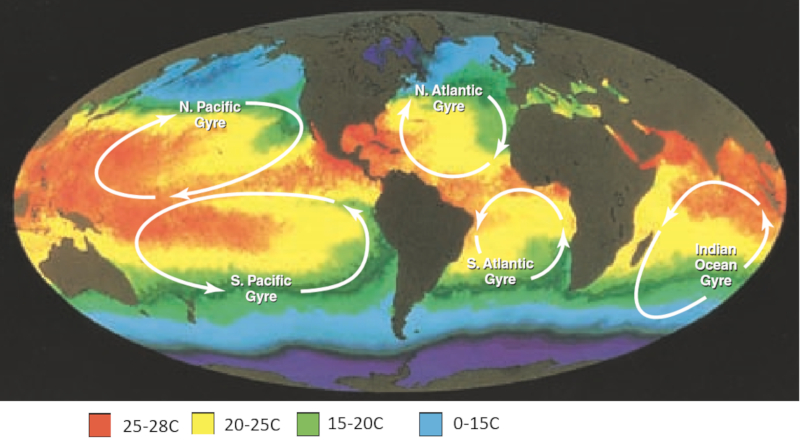
La radiaci n solar caliente ante todo el oc ano en latitudes pr ximas al ecuador. Los v rtices sin embargo pueden arrastrar aguas c lidas hacia los polos y de los polos hacia el ecuador mezclando las aguas c lidas con las fr as en las zonas polares.
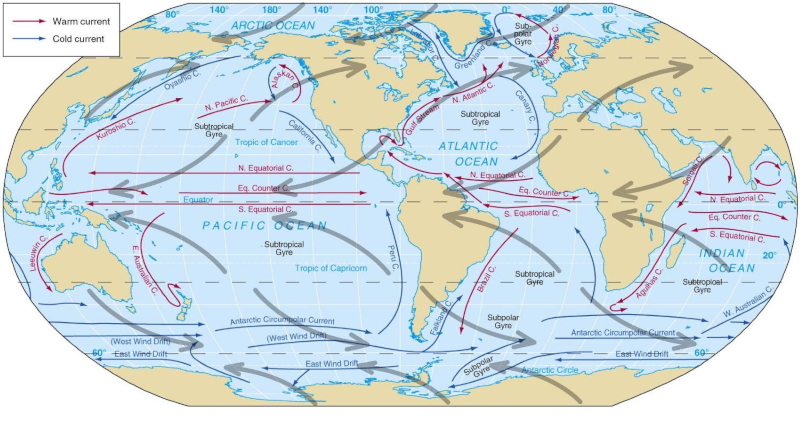
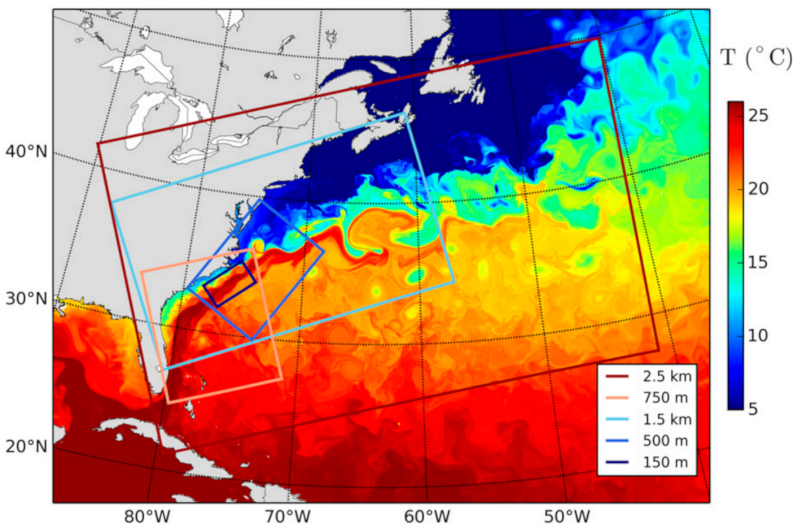
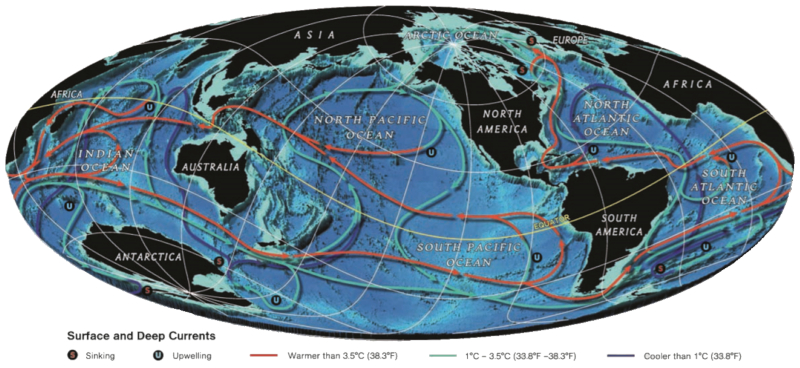
Wind-induced circulation in the atmosphere generates five major vortices: two in the Pacific, two in the Atlantic, and one in the Indian Ocean.
As anticipated by Coriolis law these rotate in the northern hemisphere in the negative direction (clockwise) and positive in the southern hemisphere (counterclockwise) ).
They are classified as cold and hot according to the temperature they are acquiring in the equatorial and polar zones.
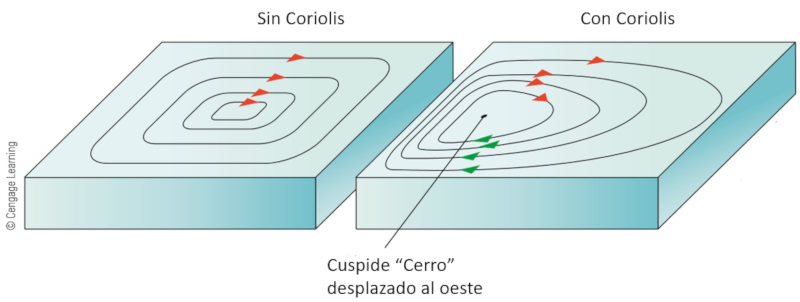
Como la fuerza de Coriolis es nula en el ecuador y crece en direcci n de latitudes mayores las corrientes que viajan desde el ecuador hacia los polos tienden a ser angostas. Sin embargo, a medida que se aproximan a los polos, las fuerzas de Coriolis tienden a desviarlas hacia el lado este (hemisferio norte)/oeste (hemisferio sur) de la corriente llevando a un ensanchamiento de la corriente.
Por ello las corrientes que regresan en direcci n del ecuador tienden a ser mas anchas, existiendo distorsiones por islas y superficies muy extensas (pacifico).
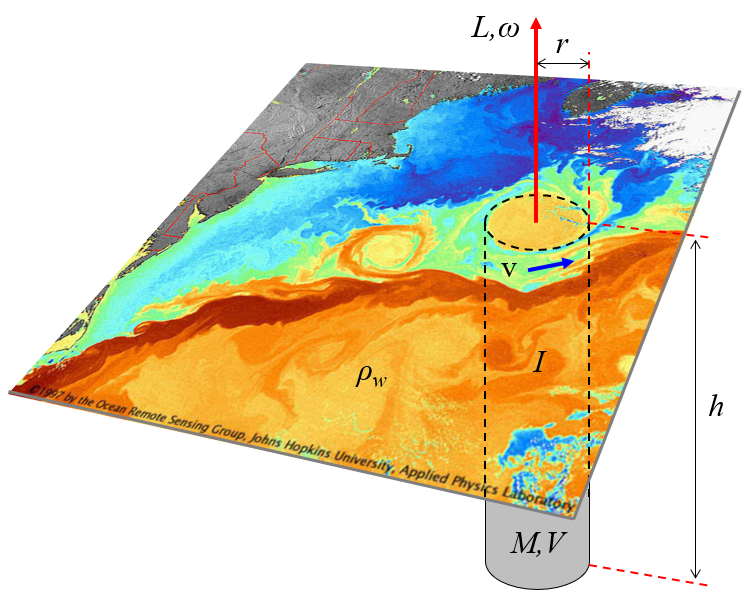
En situaciones en que corrientes de distinta temperatura interactuan se forman v rtices mediante la separaci n de reas de la corriente principal que por el movimiento relativo de las corrientes giran. Estos v rtices presentan inercia que hace que tiendan a mantener su forma y viajen en una de las corrientes largos recorridos antes de desarmarse.
En estas laminas se muestra la formaci n de v rtices menores en mas detalle:
• dos corrientes interactuando
• por fluctuaciones se forman protuberancias que invaden el rea de la otra corriente
• reas comienzan a girar
• por inercia mantienen la forma e incursionan en la otra corriente
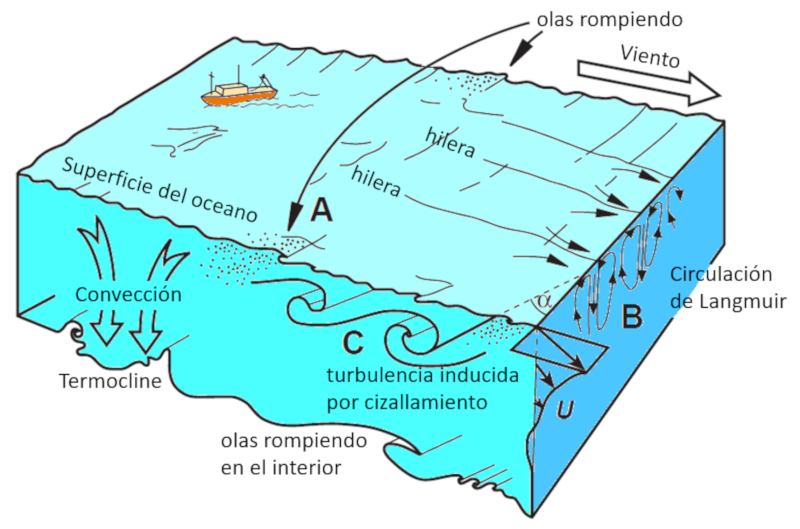
Al simplificar las ecuaciones de la ley de Coriolis se obvian movimientos fuera del plano. Sin embargo para movimientos de masas de agua estos si pueden existir y generar aceleraciones hacia la superficie que con
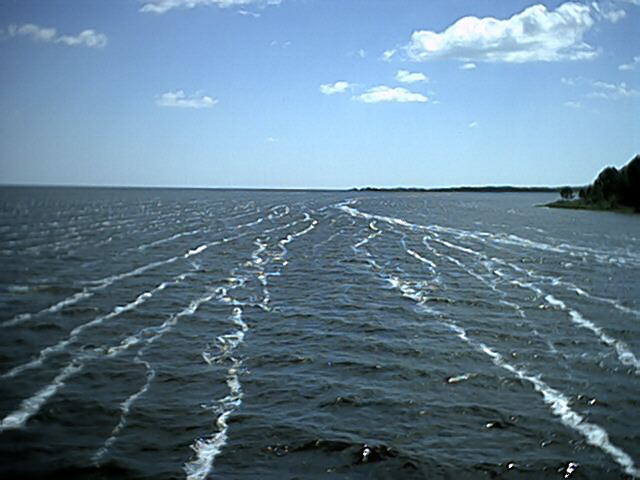
Si se suma a esto la tendencia de que con movimientos hacia el norte en el hemisferio norte existen desplazamientos en la superficie hacia el este se generan circulaciones dentro de una capa de algunos metros. Estas forman verdaderas 'trompas' que se localizan en forma paralela y se van alternando en el sentido de rotaci n. En los puntos de convergencia se pueden acumular algas y basura creando largas lineas de objetos que flotan.
View from the air of Langmuir circulations: convergence zones form depressions and divergences form protrusions.
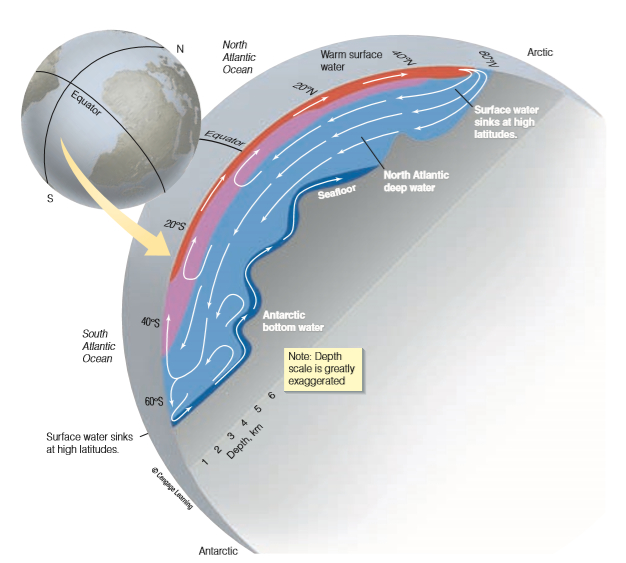
La densidad del agua (efecto de salinidad) genera una parte del flujo se 'hunda' participando en lo que son las corrientes de profundad o 'afloren' y participen en las de superficie.
Como las corrientes de la profundidad no dependen de los vientos no est n sujetas a la din mica de la superficie que se separa por la fuerza de Coriolis en circulaci n separada por hemisferios.
The deep current extends over the entire globe also spreading warm and cold currents . This depends on the point at which it is fed by surface currents :
To simplify the equations, we work with ERROR:8600.1, which is a constant for the physical location, as it includes the angular velocity of the planet ($\omega$) for the Earth and the latitude ($\varphi$) for the location:

In the southern hemisphere, the latitude is negative, and with it, 8600, explaining why systems rotate in the opposite direction to the northern hemisphere.
To simplify the equations, we work with ERROR:10273.1, which is a constant for the physical location, as it includes the angular velocity of the planet ($\omega$) for the Earth and the latitude ($\varphi$) for the location:
As the coriolis acceleration in x direction ($a_{c,x}$) can be rewritten with the coriolis factor ($f$) and under the condition that there is no vertical movement:
$v_z = 0$
Therefore, it follows that the coriolis acceleration on the surface, in the x direction ($a_{c,x}$) is:
Since the coriolis acceleration in x direction ($a_{c,x}$) can be rewritten with the coriolis factor ($f$) under the condition that there is no vertical movement:
$v_z = 0$
Then, it follows that the coriolis acceleration on the surface, in the y direction ($a_{c,y}$) is:
Since the coriolis acceleration in z direction ($a_{c,z}$) can be rewritten with the second Coriolis factor ($e$) under the condition that there is no vertical movement:
$v_z = 0$
Then, it follows that the coriolis acceleration on the surface, in the z direction ($a_{c,z}$) is:
ID:(1560, 0)